

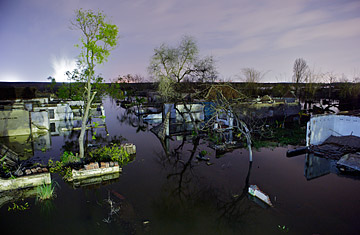
After the flood: Steam rises behind homes and businesses submerged by mud in East Java, Indonesia
On the morning of June 2, 2006, Ahmad Mudakir, a 33-year-old factory worker from Porong, a sleepy district in eastern Java, was in his front yard tinkering with his motorbike. A little after 8 a.m. he felt a rumbling in the ground — worrying, but not wholly unexpected in this seismically fitful corner of Indonesia. What happened next was anything but expected. Mudakir watched as a neighbor, who had been inside eating breakfast, came tumbling into the street. "There was an explosion," Mudakir recalls. "Then the mud started to flow." He gaped in amazement as a geyser of scalding sludge shot five meters into the air, collapsing the roof of his neighbor's house. Mudakir froze. Then he gathered his mother and two brothers from inside his own house. "The whole village was panicking. Everyone ran." Mudakir didn't stop to collect his family's belongings. He assumed he'd be able to return home.
Today, Mudakir's village, along with much of the rest of Porong, is gone, swallowed by an ash-gray lake of mud. The noxious sludge, incredibly, continues to flow at a rate of up to 5.3 million cu. ft. (150,000 cu m) a day — enough to fill 50 Olympic-sized swimming pools. In total, Porong has been smothered beneath nearly 3.5 billion cu. ft. (100 million cu m) of the stuff. The mud has buried 12 villages, displaced around 16,000 people and caused more than a dozen deaths. Porong hasn't just been destroyed; it has been erased. Where Mudakir's house once stood, there is now a vast, gurgling expanse, with only the occasional protruding tree branch or rooftop to suggest the landscape entombed beneath it.
Locals call it Lusi — a portmanteau of the Indonesian word for mud, lumpur, and the name of the nearest city, Sidoarjo. Lusi is a mud volcano, though that appellation is somewhat misleading. The mud is actually more like brackish water. And, unlike the igneous volcanoes that dot Indonesia's countryside, the underground plumbing fueling Lusi is largely mysterious. Twenty-two months after it first erupted, Lusi remains the world's most bewildering environmental disaster. "I've never seen anything like it," says Richard Davies, a geologist at Britain's Durham University and one of only a handful of experts on mud volcanoes. "It's a scene, when you see it, you can only say, 'Oh, my God, it's a complete bloody mess.'"
The destruction is total. At the eruption's epicenter — known to workers at the site as the Big Hole — a 100-ft. (30 m) plume of white smoke billows into the sky, obscuring the sun and spreading the sulfurous odor of rotting eggs. On a narrow causeway leading to the caldera, dozens of trucks idle in a queue, waiting to deliver soil for the massive earthworks meant to contain the mud. Already, they have transported more than 88 million cu. ft. (2.5 million cu m) of dirt to build eight miles (13 km) of levees around the site. Dozens of cranes work late into the evening piling the dirt atop bulwarks nearly 65 ft. (20 m) tall in places. As the mud rises, so must the levees, but so far Lusi seems to be outpacing human engineering. Twice the earthworks have been breached — most recently on Jan. 4 — flooding more houses. On Nov. 22, 2006, the weight of the soil ruptured a natural-gas pipeline, causing a massive fireball that incinerated 13 workers. According to an International Monetary Fund estimate, Lusi has already cost Indonesia $3.7 billion in damage and damage control. And things are likely to get worse. As mud spews up from the ground, the area around the eruption is gradually sinking. Eventually, Porong could become a giant sucking wound in the Earth.