

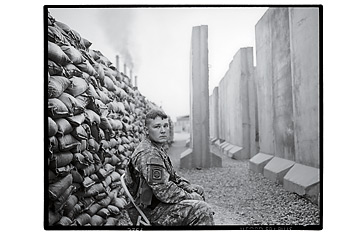
Staff Sgt. Billy Wallace, a survivor of the Karbala attack on Jan. 20, sits at Forward Operating Base Iskan. The U.S. outpost is sprawled around a power plant outside of Iskandariyah, Iraq.
(4 of 4)
Two investigators who worked on the case say there is enough evidence against the governor and others at the Karbala center to fill an indictment that would pass muster in a U.S. court. A female member of the Iraqi parliament from Babil province, Majada Discher, is suspected of involvement too. One of the vehicles used by the attackers was registered to her, and investigators say forensic evidence shows that one of her bodyguards was among the killers. In Karbala, Army investigators drew up two lists of suspects. The first list, comprising about 40 names, read like a Who's Who of local Shi'ite militants, mostly from the Mahdi Army. The second list has roughly 10 names of people the investigators dubbed "untouchables." These were people thought to be involved in the plot one way or another but considered too prominent to arrest or target, investigators said. Discher made the untouchables list, as did the governor, al-Quraishy, Shaker and Hanoon.
Though Balcavage feels that arrests are in order, the case has stalled. Brigadier General Vincent Brooks, who was a senior commander for southern Iraq at the time of the attack, says several Iraqi government officials remain under suspicion. "We haven't given up on this at all," he says. But Balcavage says political calculations can sometimes override the quest for justice. Removing a suspect police chief, for instance, could undo progress made in building up security forces and destabilize the local political leadership. "There's always second- and third-order effects for every action," Balcavage says. "The challenge is that you're working with a government you want to see succeed. But our values and the values of certain members of the government are not necessarily consistent. Our idea of good and their idea of good are not always the same."
As a result, working with Iraqi security forces and their leaders is becoming increasingly hazardous for many Americans in Iraq. Diaz, for example, sometimes still works with Hanoon, who was heard laughing into his cell phone the night of the Karbala attack. Hanoon is now the police chief of Iskandariyah. Diaz says his soldiers assume that Mahdi Army operatives are in their midst whenever they visit Hanoon, who works not far from the U.S. base at which pictures of the five Americans hang on a wall dedicated to the fallen.
When Iraqi authorities discovered the abandoned vehicles on the night of Jan. 20, Freeman was the soldier clinging to life. For a moment before the Americans finally arrived, the Iraqis thought Freeman might still have a chance. They could have waited for U.S. soldiers to come, but Freeman needed care immediately. So the Iraqis acted on their own. They pulled Freeman from the back of the vehicle and loaded him into an ambulance. An Iraqi army soldier administered CPR until a medic could give him oxygen as they rushed to the nearest hospital in Hillah. But Freeman's wound was too severe, and he died along the way.
"I would like to tell the family that we tried to help him so that he would live," the Iraqi soldier later told U.S. investigators who took a statement from him. "We are very sorry that he died. We treated him as if he was our own."