

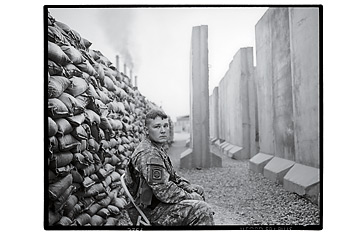
Staff Sgt. Billy Wallace, a survivor of the Karbala attack on Jan. 20, sits at Forward Operating Base Iskan. The U.S. outpost is sprawled around a power plant outside of Iskandariyah, Iraq.
The five sport-utility vehicles sat abandoned in the darkness. A faint beeping sound signaled that their doors were open. Some of the Iraqi police who arrived at the scene initially feared going near the cars, thinking the sound meant they were rigged to explode. Finally a few ventured closer. In the back of two of the vehicles were the four Americans. One of them was alive, though barely. Handcuffed, he had been shot in the back of the head, but he was breathing. The other soldiers were already dead. One had taken bullets in both legs and his right hand, and at some point the kidnappers had torn open his body armor and fired bullets into his chest and torso. Two others were handcuffed together, with one's right hand joined to the other's left. Two shots in the face and neck had killed one. Four bullets in the chest had killed the other.
None of the soldiers had identification. The killers had taken everything from the men's pockets before fleeing the scene. In his last moments, one of the soldiers, a young lieutenant, realized his body might be unidentifiable when he was discovered. In the dust caked on one of the vehicles he managed to write his last name, Fritz, a final act before dying.
To many Americans, the Jan. 20 murder of four U.S. soldiers on a deserted road in southern Iraq might sound similar to countless other tragedies in a bloody, brutal war. There was a firefight, which killed another American; a brazen abduction; then a frantic chase leading to a heartless end. And yet from the start, the deaths of the five Americans were also shrouded in mystery. The attack took place in Karbala, a Shi'ite holy city of roughly 1 million people that had been one of the safest in Iraq for U.S. troops. It happened in plain sight of Iraqi police the Americans had been assigned to train. The killers wore U.S.-style uniforms, suggesting a catastrophic lapse of security --or the possibility that the enemy operation had actually been an inside job.
The military has struggled to affix responsibility for the Karbala murders. U.S. commanders have accused the Quds Force, a paramilitary organization run by members of Iran's security establishment, of being behind the operation. On July 2 in Baghdad, the military revealed it was holding Ali Musa Daqduq, a Lebanese national who was captured in Basra in March. He is a senior operative of Hizballah (the Lebanese Shi'ite militia supported by the Quds Force), and officials say he has admitted to involvement in the attack.
U.S. officials, who met their Iranian counterparts in Baghdad on July 24, have used the Karbala killings as evidence that Iran is sponsoring attacks on U.S. forces in Iraq. But the full story of what happened that night may be even more tangled and disturbing, raising questions about the loyalties of some of the Iraqis whom U.S. troops are risking their lives to protect and support. An internal Army investigation into the attack reviewed by TIME, in addition to interviews with U.S. and Iraqi witnesses, suggest that the abduction and murders were carried out with the knowledge and complicity of Iraqi Shi'ite police who only hours earlier had been working alongside U.S. soldiers--and may have involved local officials loyal to the government of Prime Minister Nouri al-Maliki. The Karbala incident highlights the dilemmas facing the U.S. as it weighs whether and how to redeploy its troops from the front lines of the war. In some cases, the Iraqi security forces being trained and equipped by the U.S. retain ties to anti-American militia who could turn on U.S. troops as they depart. (On July 13, U.S. troops killed six Iraqi police in a raid targeting a rogue police commander.)
That's particularly unnerving given the military's push to embed more U.S. troops with Iraqi units. In Baghdad today, U.S. and Iraqi forces serve together in 65 combat outposts, up from 10 in February. But U.S. troops never went back to work with the Iraqis in Karbala, where the trust and friendships forged over many months ended in one night of betrayal and murder.
Most of the soldiers from Forward Operating Base Iskan, just south of Baghdad, liked the missions to Karbala. It was a chance "to get away from the flagpole" and all the bureaucracy of life back at the main base. In Karbala, roughly 30 men were on their own for a week or so at a time, staying at the city's governance center, where the police headquarters sat next to the governor's office. The two-hour drive from Iskandariyah could be nerve-racking as they eyed the edges of the route for roadside bombs. But once at the Karbala Provincial Joint Coordination Center, life was simple and good in the way soldiers like.
Much of the unit had come together in the early months of 2006 at Fort Richardson, an Army base just outside Anchorage, Alaska. Jacob Fritz had graduated from West Point in 2005. Built like a football lineman, Fritz had grown up a Nebraskan farm boy in the town of Verdon, where his graduating class in high school had only 11 students. At West Point, Fritz earned the nickname "Jolly Jake" for his perpetual smile. The soldiers from Fort Richardson grew to like Fritz too. He had the kind of résumé you see among the young élite of the Army's officer corps. But early on, the enlisted men considered Fritz one of their own.
Johnathan Chism was a young Army specialist with a thick accent from his native Baton Rouge, La. The other guys called him "Gator," and Chism listed his ethnicity on MySpace as Redneck/ Southern. Johnathon Millican, 20, a private from Alabama, also spoke in a thick Southern accent and was the unit's resident comedian. Private Shawn Falter was from upstate New York and enlisted in the military in 2005, following three older brothers who served in the Army and the Marines. He liked country music. On the weekend before he deployed to Iraq in 2006, Falter was out with Staff Sergeant Billy Wallace and some others, singing karaoke. For his turn at the microphone, Falter sang the words to the Tracy Lawrence ballad If I Don't Make It Back.
In Karbala, Fritz led some of the missions on his own. At other times, Captain Brian Freeman took the lead. Freeman was, in essence, the chief U.S. liaison to Iraqi officials in Karbala, including Governor Akil Mahmood Khareem and police chief Mohammed Muhsin Zeidan al-Quraishy. At 31, Freeman was older than most of the other troops. He had graduated from West Point in 1999, served his obligatory five years of active duty and then settled into civilian life in Temecula, Calif., where he had a wife, a year-old son and another child on the way. Freeman had left active duty but remained a member of the Individual Ready Reserve Unit, which keeps a number of trained soldiers ready to call for deployment if needed.