

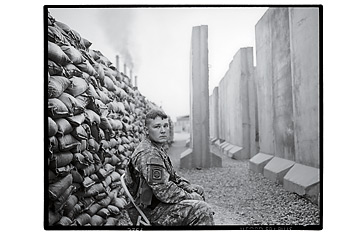
Staff Sgt. Billy Wallace, a survivor of the Karbala attack on Jan. 20, sits at Forward Operating Base Iskan. The U.S. outpost is sprawled around a power plant outside of Iskandariyah, Iraq.
(3 of 4)
Lieut. Nathan Diaz was in an upstairs room of the police headquarters with 18 other soldiers as the clash began. Like most of the other troops, Diaz initially thought the explosions were incoming mortars or rockets fired from insurgents outside the base. Diaz moved to the roof along with other soldiers and began shooting out lights around the courtyard so the troops would be harder to see if snipers were about. Diaz peered over the ledge into the courtyard just in time to see a humvee explode, sending up a shock wave that knocked him onto his back. Diaz and the other soldiers then decided to clear the roof, still thinking mortars were falling. Going downstairs, Diaz moved along the hall on the second floor where the police chief, al-Quraishy, and his two deputies, Ra'aid Shaker and Majed Hanoon, kept their offices. Soldiers called the chief's squad of personal bodyguards the "commandos." If there were any sign of trouble, the commandos would typically respond before the Iraqi police. But this time they barely moved as Diaz and other Americans rushed by. "I didn't really think much of it at the time, but very soon after, that became very strange," says Diaz, who came to believe that whoever was attacking the center had help from the inside.
After rescue helicopters had carried away Millican and three other wounded, Diaz confronted al-Quraishy, Shaker and Hanoon. How could this have happened? Al-Quraishy was supposed to be one of the best commanders the Iraqi security forces had. Nicknamed "the Wolf," he made a name for himself in Mosul in 2004 and '05, often appearing on an Iraqi true-crime television show called In the Hands of Justice, chasing down and personally interrogating militants. The Americans hoped al-Quraishy, who took over leadership of the Karbala police in the fall of 2006, could stand up to the Mahdi Army in southern Iraq. But Diaz and others believed that, at the least, some of al-Quraishy's police had let the Jan. 20 attackers into the main building without offering any resistance. During the fighting inside, none of the Iraqi police or the commandos did anything to help the Americans. "No one was shot," says Sergeant First Class Michael King, describing the Iraqi police immediately after the attack. "No one twisted an ankle. No one jammed a thumb. Nothing." Al-Quraishy was apologetic but offered no explanation. "You really can't tell with that guy," Diaz says. "Either he was sincere, or he's a great actor. It's really almost impossible to interpret."
The Karbala attack came days after the U.S.'s Jan. 11 arrest of five alleged Iranian operatives in Irbil, in northern Iraq. Military officials have theorized that the Karbala attack was orchestrated by Tehran in retaliation. But the U.S.'s initial probe of the incident found no evidence of direct Iranian involvement. Instead, the picture that emerged cast suspicion chiefly on senior Iraqi officials known to the Americans, as well as local thugs and associates of al-Sadr. The report on the investigation, which has been released only to the families of the soldiers who were killed, found that "it is too coincidental that the attackers, already argued as outside professionals, knew and raided only the two rooms where the Americans resided and were able to isolate the barracks-area soldiers and rooftop defenders." The report adds that many Iraqi police seemed to disappear moments before the assault and that the attackers seemed to know that the Americans would initially go to the rooftops during an attack, a drill U.S. troops had practiced in front of the senior Iraqi officers.
One source of dispute is whether the attackers were wearing U.S. uniforms, which Iraqi police claimed is the reason they didn't shoot. The man Wallace saw, however, was dressed in Iraqi army fatigues, which are sometimes worn by Iraqi police as well. "This all suggests that someone provided more than just a layout of the compound and knowledge of the Coalition Forces' battle drill," the report says. "It appears an inside assault force was pre-staged."
Since Jan. 20, the military has begun to identify militants thought to have taken part in the attack. On March 22, the U.S. military announced the arrest of Qais Khazali and his brother Laith, saying the two were apprehended in Basra and Hillah for allegedly playing a role in the Karbala attack. Khazali was a protégé of al-Sadr's in 2004 and '05, but his relationship to al-Sadr and the Mahdi Army is unclear these days. Investigators who questioned Khazali say he was working closely with the Iran-backed Quds Force before his capture and was leading a group of Shi'ite militants who trained in Iran. Khazali had traveled frequently to Iran for what appears to be weapons smuggling, U.S. military officials in Baghdad said. In May, U.S. forces killed Sheik Azhar al-Dulaimi after cornering him on a rooftop in Baghdad's Sadr City; investigators say they uncovered forensic evidence that shows al-Dulaimi was among the men who abandoned the vehicles used in the operation. On July 2 in Baghdad, the military revealed the capture of Ali Musa Daqduq, the purported Hizballah operative. "Both Ali Musa Daqduq and Qais Khazali state that senior leadership within the Quds Force knew of and supported planning for the eventual Karbala attack that killed five coalition soldiers," says Brigadier General Kevin Bergner, the U.S. military spokesman in Baghdad.
But is that the full story? The gunmen who arrived at the Karbala center were obviously skilled guerrillas, and it is certainly possible that some among them had come from as far away as Lebanon or Iran. But that does not explain whether any of the Iraqi officers at the center knew the killers were coming or whether any joined the attack or helped the kidnappers get away. The Americans interviewed by TIME say at least some Iraqi police at the center were involved, and the conclusions of the military investigation support that view. But neither U.S. nor Iraqi authorities have brought charges against any Iraqi police present at the time of the ambush.
Questions also remain about whether Iraqi politicians had prior knowledge of the attack. Lieut. Colonel Robert Balcavage, ground commander of U.S. forces operating in Karbala and surrounding areas, says Khareem, the governor of Karbala, knew many details very soon after the attack that night, which made Balcavage wonder if he knew of the operation beforehand. The Army investigation cites unconfirmed reports of calls from the governor's office to the outer checkpoints as the attackers were approaching, with orders to let them pass. In an interview, Khareem denied any wrongdoing. "To accuse me of involvement in this attack is to slight me," Khareem says. "Before anybody accuses me, they should have solid evidence. No charges have been brought against me, by any Iraqi or by the American side, so there's nothing to discuss."