

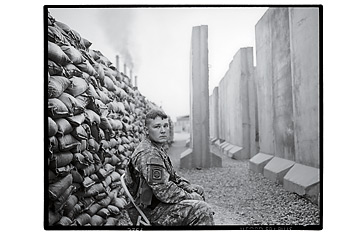
Staff Sgt. Billy Wallace, a survivor of the Karbala attack on Jan. 20, sits at Forward Operating Base Iskan. The U.S. outpost is sprawled around a power plant outside of Iskandariyah, Iraq.
(2 of 4)
By late 2006, Freeman's work in Karbala seemed to be going well. The U.S. planned to leave the center entirely in the hands of the Iraqis by the spring of 2007. But Freeman was uneasy about the job . He was an armor officer, more used to dealing with tanks and cannons than Iraqi politicians. Yet in Karbala he was a civil-affairs official, doing work he felt was more for a diplomat than a soldier. Shortly before Christmas 2006, Freeman took a short leave to visit his family in California, making his way to Baghdad for a helicopter flight on the first leg of the journey. At Landing Zone Washington, the main helipad inside the Green Zone, Freeman spotted Senators John Kerry and Christopher Dodd, who were on a visit to Iraq. He introduced himself and began voicing some of his concerns. Freeman kept in touch with Dodd after they parted in Baghdad, reiterating his thoughts in an e-mail. "Senator, it's nuts over here," Freeman wrote. "Soldiers are being asked to do work we're not trained to do. I'm doing work that the State Department people are far more trained to do in fostering diplomacy. But they're not allowed to come off the bases because it's too dangerous here. It doesn't make any sense."
Freeman felt certain that the Iraqis he and his soldiers were supposed to be helping did not want them there. He and other troops suspected some of the police were members of the Mahdi Army, the militia of radical anti-American Shi'ite cleric Muqtada al-Sadr. That's not unusual, given that the largely Shi'ite personnel of Iraq's Ministry of Interior have long been seen as a de facto wing of the Mahdi Army. National police are suspected of taking part in the militia's sectarian killings in Baghdad. And in southern Iraq, where al-Sadr is powerful, infiltration of U.S.-trained Iraqi units is common. But even the wariest Americans have trouble believing that Iraqis who look them in the face each day could muster the audacity to try to kill them.
By early this year, Freeman was beginning to question the assignment. He was having trouble sleeping during his stays in Karbala. When he returned from leave in January, he asked his commanding officers if he could skip the Karbala mission heading out Jan. 14. He suggested doing some other long-term projects at the main base. Not doable, Freeman was told. The mission was heading out as scheduled, with him in command.
Many soldiers sensed a changed mood when they arrived at the Iraqi police headquarters in Karbala on Jan. 14. Some of the Iraqis the soldiers had been working with since the fall seemed unusually tense. One Iraqi police officer heckled some soldiers at the back gate in broken English, saying "U.S.A. bad, Iraq good" before throwing bread at them. Another aired an ominous warning. "Tomorrow," he said to soldiers standing guard outside, pounding a fist into his palm. "Tomorrow."
On Jan. 20, all except the guards posted at the back and front gates were at rest in the barracks area of the concrete headquarters building, where troops were scattered across two floors. At about 6 p.m., just as the sun was setting, a series of shots rang out, sounding much closer than the occasional gunfire heard in the area. Then two huge booms shook the ground from the inside. The soldiers scrambled into their armor and reached for their weapons. On the first floor of the main building, Wallace saw the door to the room he shared with Millican and three other soldiers open from the outside. Sergeant First Class Sean Bennett instinctively slammed it shut with his right shoulder. But the attacker in the hall still managed to cram the muzzle of an AK-47 into the doorjamb and let fly a stream of bullets. "The guy just opened up," says Wallace, who threw his left side against the door as the firing continued. "He started blasting all over the room the best he could."
Somewhere in the struggle, a grenade bounced into the room. Millican dived, catching bullets in his body as he went down and absorbed the explosion. He had been chatting online with his wife Shannon when the fighting broke out. A minute later, he was dead.
The explosions blew open an adjacent room where Freeman and Fritz worked. Then the door to Wallace's room flung open once more. Wallace looked up to see a man in the same desert-camouflage fatigues normally worn by Iraqi army soldiers; he was standing 2 ft. from him and taking aim with an AK-47. Wallace and Bennett threw their shoulders back into the door. The barrel caught in the crack a second time, and more bullets crashed around the side of the room. Seconds later, a massive explosion in the hall disintegrated the door around Wallace and Bennett, who was left badly wounded along with another soldier in the room, Jesse Hernandez. More blasts outside sent flames and smoke coursing through the darkening courtyard, where Falter and Chism had been standing guard. One of the humvees parked there was ablaze, and rounds from the turret gun began cooking off as the attackers rushed away.
As the troops tended to their wounded and waited for rescue helicopters to arrive, they realized Freeman, Fritz, Chism and Falter were missing. The attack had lasted just five minutes.
How did the attackers breach the base's security? A report from the military's investigation of the incident, a copy of which was obtained by TIME, says a convoy of eight sport-utility vehicles arrived at the outer gates of the complex shortly before the shooting started. The vehicles included a tan Suburban, a white Land Cruiser and a black Yukon. Inside the vehicles were at least eight men who wore American-style helmets and safety glasses, as well as some men wearing hoods in the way Iraqi interpreters working with U.S. forces sometimes do. According to the report, the Iraqi guards at the outer checkpoints put up no fight when the visitors ordered them, in English, to lay down their weapons and step aside.