

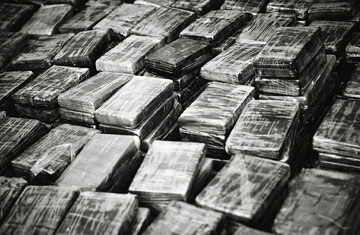
At Police Headquarters, packets of seized drugs, ready for inspection by Interpol
The four men park their sport-utility vehicle in the back lot of a five-star hotel, size me up carefully and make their offer: I can sample some high-grade cocaine, and then buy 7 kg for about $78,000 — roughly one-quarter of what I can sell it for on the streets of London, Amsterdam or elsewhere in Europe. It has taken me — a stranger in town — just one afternoon to locate a sizable drug deal.
If Guinea-Bissau had the money to paint a sign for arriving visitors, it might read: welcome to the world's newest narco state. This small country in West Africa is such a perfect base for cocaine operations that it could have been designed by Pablo Escobar himself. Escobar and other Colombian drug lords poured untold tons of cocaine into the United States in the 1980s, setting off a narcotics epidemic across urban America, and leading to drug wars which have taken decades and billions of dollars to combat.
Now it looks like Europe's turn. Cocaine use has roughly tripled in Europe over the past decade, while U.S. consumption of the drug has tailed off, according to U.N. figures released in June. Although only 3% of Europeans report having taken cocaine, according to the European Monitoring Center for Drugs and Drug Addiction in Lisbon, officials say the figures are far higher in urban areas of Britain, Spain and the Netherlands, and that it's gaining popularity across Europe. Cocaine use is now higher in Spain than in the U.S., according to the U.N., and authorities fear that the Continent may be heading down the same path from which the U.S. has just started to emerge. Some admit that they are badly unprepared for what's happening. "It's caught us by surprise," says Carel Edwards, head of the European Commission's drug coordination unit in Brussels.
Europe's open borders are a strong draw for traffickers, because they allow smugglers to move with relative ease across the Continent, which contains millions of people with money to spend. The strong euro is also a lure. A kilogram of uncut cocaine wholesales for about $40,000 in Spain — roughly double the U.S. price. (In Russia and Norway, one kilogram can fetch up to $120,000.) Divided into street-sized amounts, a kilogram can earn five times those figures. Since moving in on Europe in the mid-'90s, the cartels — overwhelmingly Colombian, but also Venezuelan and Mexican — have hugely ramped up operations.
But the Latin American drug lords faced one big hurdle in targeting the European market: geography. Europe is thousands of kilometers from Colombia, Bolivia and Peru — home to the world's entire crop of coca leaves, from which the white powder of cocaine is refined. And Europe's sophisticated airport security systems and coastal patrols have made it tough to ship massive volumes of cocaine undetected. That means the cartels need transit points where they can store the huge amounts of the drug that they have moved across the Atlantic. It can then be divided among hundreds of smugglers who can individually sneak it into Europe — and who are desperate enough to take the risk.
Africa provided the cartels the way stations they needed to create an efficient global smuggling machine. According to a senior drugs intelligence officer at Interpol, the cartels now export between 200,000 and 300,000 kg a year to West Africa destined for Europe. "What is emerging is a substantial trafficking scheme involving suspects on three continents: Africa, Europe and South America," says the officer, who could not be named. "This is one of the world's biggest generators of illicit cash."
And supply is only likely to increase to meet a growing demand. "In the next few years, cocaine will spread into the whole E.U.," says Koli Kouame, head of the United Nations International Narcotics Control Board in Vienna, who is from the Ivory Coast. "It is simple: the youth in Warsaw want to be like the youth in London or Paris, so it will spread fast."