

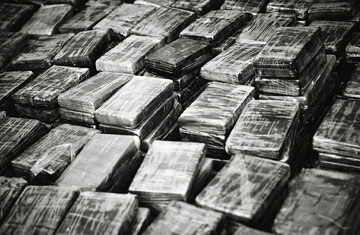
At Police Headquarters, packets of seized drugs, ready for inspection by Interpol
(3 of 4)
Government officials say they have too little money and not enough weaponry or personnel to stop drug trafficking. "Cocaine is a big, big problem," says Barnabé Gomes, spokesman for the country's President, João Bernardo Vieira. "We need help to do something." He says what's needed is Western intervention to stop traffickers transiting through Guinea-Bissau: "Europe is not doing much to help. We are even asking the United States to help us." In Bissau's crumbling port, Portuguese naval Sergeant Jorge Padua says he arrived last March to help Guinea-Bissau apprehend illegal fishing boats plying its waters. "The government has never asked us to stop the drug traffickers," Padua says.
So European governments are faced with the challenge of outwitting traffickers thousands of kilometers away. "They are looking for safer routes and methods," says María Marcos, director of Spain's Intelligence Center Against Organized Crime in Madrid. The routes and methods vary. Some cocaine is shipped on large vessels directly across the Atlantic, often having been processed at sea. Marcos says this cocaine is sometimes dropped overboard attached to floating buoys, then collected by Africa-based traffickers. The rest is flown from Latin America on twin-prop planes to West Africa, where it is offloaded and shuttled to Europe on smaller planes or via boat.
Desperate for an arrest, Guinea-Bissau's judicial police finally borrowed cash for fuel and hired cars to drive 50 km east of Bissau, where they intercepted the convoy the villagers had described. They found 635 kg of cocaine, worth about $80 million in parts of Europe — more than one-quarter of Guinea-Bissau's annual gross domestic product. Inside the car were two military men, whom officials in Bissau recognized as bodyguards of a senior army officer. The police burned the cocaine, but the military later quietly released the two arrested men without charge. Having witnessed such things, senior officials are now open about the military's involvement in trafficking. "There are people in power who are connected to it," says navy Commander José Américo Na Tchutu, one of the military's top officials. "It is sad but true."
After months of failed attempts to stop the trafficking, Guinea-Bissau's judges claim that the military has effectively blocked any effort to end the trade and that it's protecting the cartels. "The military has impunity and we have no protection," says Judge André Lima. He says the military has forced judges to sign release orders for those arrested on drug charges. "What is sad is that we are forever prosecuting people who steal one chicken or a cow," says Lima. "But [cases involving] drugs will never get to court."
Since the police arrest few traffickers, people sense little danger in the business. To many Africans involved, cocaine is a drug used by Europeans and Americans, not them, and the easy money it provides is just good business. "Everybody is saying that this is a blessing from God because the government does not have the money to pay people," says a local journalist in Bissau.
Meanwhile, as the cocaine trade with Europe booms, the cartels have also spread into other African countries. "It's not just Guinea-Bissau," says Antonio Mazzitelli, West African director of the U.N. Office on Drugs and Crime. "It is also Liberia, Sierra Leone, Ghana and others" — countries, in other words, where the justice system has all but collapsed, where prisons are overcrowded, and where there are too few judges and courtrooms to provide efficient trials.
Interpol estimates that about two-thirds of all the cocaine destined for Europe flows through West Africa. Some of the shipments that law enforcement authorities have been able to track down have been enormous. In May, a Cessna 441 twin-prop aircraft registered in the U.S. offloaded 630 kg of cocaine at an airport in Mauritania, and took off again. The crew then abandoned the aircraft in the desert about 125 km away and fled. Mauritanian police believe the scheme involves European dealers, and have questioned Belgian and French citizens. In early June, police in Belgium said they had cracked a cocaine network that had shipped about 350 kg in unchecked luggage through Brussels International Airport from Sierra Leone and Gambia. Airport staff apparently slipped the drugs into Europe without inspection, according to accounts by Belgian journalists.