

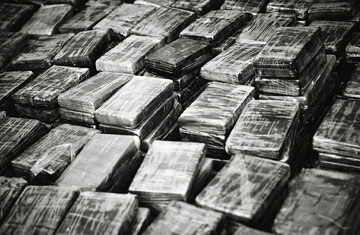
At Police Headquarters, packets of seized drugs, ready for inspection by Interpol
(2 of 4)
By far the leading African connection in this growing global network is Guinea-Bissau. The fifth poorest country in the world was perfectly suited to playing a key role in the coke trade. The average person in this country of 1.6 million people earns about $720 a year and dies at 45. The capital, Bissau, is a decrepit relic on which the government has not slapped a lick of paint since the Portuguese colonials decamped in the 1970s. There are few phone lines and almost no electricity. Even the President's office building has a generator roaring outside. The judicial police headquarters has no working communications radio, computer or phone. Its four police cars all need repair, and there is no money for fuel. In theory, police officers earn about $100 a month. But — like the nation's judges, soldiers, bureaucrats and Cabinet Ministers — they have not been paid since January. Civil servants received only three months' pay last year. The country also has no prison. In the squalid lockup in the judicial police compound, 66-year-old Aboubakar Seidi stumbles to his feet from a grimy sponge mat, and tells me he has spent five months there with no trial or lawyer's visit. He's suspected of knowing who killed a military commander last January, but he insists: "I know nothing."
Like its poverty, Guinea-Bissau's landscape proved ideal for drug cartels. Its 350-km coastline, with 50 or so uninhabited islands, offers excellent drop-off points for drug vessels, and planes can deliver drugs to any number of Portuguese-built airstrips that have been abandoned for years as the country has no planes. "This is an open space where you can do anything," says a military officer from another African country who is stationed in Guinea-Bissau as part of a cooperation agreement. "There is no plane. No radar. Nothing."
Colombians began to rent houses in Bissau in 2004, declaring themselves exporters of fish or cashew nuts, while in reality coordinating industrial-sized shipment and storage of cocaine from Latin America. One afternoon, an undercover detective drives me around Bissau to point out the mansions where the Colombians live. Erected on dirt lanes, they have Romanesque columns, walls with kitsch pastoral mosaics, and satellite dishes on their Spanish-style tiled roofs.
Police sources in Bissau claim the Colombians are protected by the military, which appears to allow them free rein. They are not certain whether the soldiers are paid in return, or whether they are themselves involved in trafficking. Certainly there are signs of a fresh influx of money. In a new neighborhood on the edge of town, about 20 mansions owned by government officials are under construction, many with pools and multiple wings.
Last September the judicial police raided one of the Colombian-rented houses in Bissau and found 674 kg of high-grade cocaine. They drove the drugs and the two Colombian tenants to the police lockup, says Gabriel Madjanhe Djedjo, the judge who handled the case. Within an hour of the arrests, he says, military officers surrounded the compound, demanding the drugs and threatening to shoot their way in. The police relented, and the soldiers loaded the cocaine — stored in 1-kg packets — onto a pickup truck and drove it to the crumbling Treasury building, where they placed it in a locked vault. Within days, the entire load vanished. "The drugs were for [the military]," says Djedjo. Shortly after, the Attorney General ordered Djedjo to release the Colombians, he says; the men were never seen again.
By April, the country had become so swamped with cocaine that radio journalists in Bissau broadcast an appeal for villagers to phone in with details of mysterious activities. Locals near the airfield of Cufar quickly called on their mobile phones to describe major drug drops. Crucially, they exposed the military's deep involvement in the trafficking. "People called and said: 'Here is a plane landing, now they are offloading packets, now the military is coming, the military is loading it and driving toward Bissau,'" a local journalist told me.