

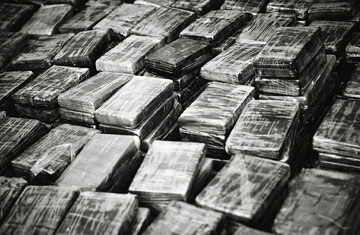
At Police Headquarters, packets of seized drugs, ready for inspection by Interpol
(4 of 4)
So far, the destination country hardest hit by the new drug pipeline is Spain. Cocaine has flooded into Spain on smuggling boats, some of which use the same extensive networks that carry illegal migrants. Officials believe that Colombian cartels have long-standing connections in Spain, based partly on their shared language, and that smugglers have converted their old hashish trade into more lucrative cocaine operations. "They are taking advantage of the old marijuana routes into southern Spain," says Matilde Duque, spokeswoman for Spain's Ministry of Health antidrug plan. "The infrastructure is already in place. They are just changing the cargo." Last year, Spanish police seized 46 tons of cocaine in joint operations with British, Italian and Dutch drug patrols, while Portuguese officials intercepted about 30 tons. By comparison, only about 74 tons of cocaine were seized in all of the E.U. countries in 2004, the latest figure available from the European Monitoring Center for Drugs and Drug Addiction. Civil Guards at Madrid Barajas Airport have found cocaine on thousands of small-time mules, who hide the drug in bullfighter's swords, guitars and tubes of toothpaste or shaving cream.
With supplies booming, cocaine has pervaded Madrid's clubs and bars in the past two years. On a recent Saturday night in one of Madrid's hottest nightclubs, a long line formed outside the restrooms as people waited their turn to snort cocaine inside. "It's one of the most popular drugs, like ecstasy in other European countries," says Federico, a music producer in Madrid. "Most people sniff a line or two at weekends. You have a drink, you have dinner with friends, then you go to a club and share a gram or so of coke. It doesn't mean we're addicted."
Beyond the risks of addiction, however, officials warn that there are dangerous links between the drug business and funding for terrorism — an argument that U.S. authorities use to press European governments to crack down on drug networks. They point to the fact that the explosives used in the Madrid train bombings of 2004, which killed 191 people, were bought with hashish. "We are seeing increasing incidents of the use of drug barter for munitions in terror attacks," U.S. Drug Enforcement Administrator Karen Tandy told international law-enforcement officials at a meeting in Madrid in May.
Seven European governments will open a drug intelligence and operations center in Lisbon later this year. These countries — Spain, Ireland, Britain, the Netherlands, Portugal, Italy and France — will coordinate with U.S. intelligence officers, and plan to begin surveillance flights over the Atlantic in July. They will also coordinate military and police patrols at sea to try to intercept Latin American drug vessels before they reach Africa or Europe. "Whichever warship is nearest will take the vessel and the drugs to Portugal," says Edwards, of the European Commission's drug unit.
But West Africans, having seen the sophistication of smugglers in their region, see little chance of Europe ending cocaine smuggling. "Even in the U.S. the government spends billions of dollars a year on the Coast Guard, but traffickers are always, always ahead of them," says Kouame of the U.N. narcotics control board. A local journalist in Bissau who has traveled to Europe illicitly with West African smugglers says boatmen in the region are adept at avoiding authorities, having spent decades smuggling people, goods, fuel and various drugs. At least some of those drugs ended up in the hands of the four men who parked behind my hotel in Bissau and offered to sell me 7 kg of cocaine. After concluding I was not a likely customer, they drove off. But in Bissau, the world's newest and perhaps poorest narco state, they will soon find someone to buy the drugs — and eventually send them to the rich streets of Europe.