

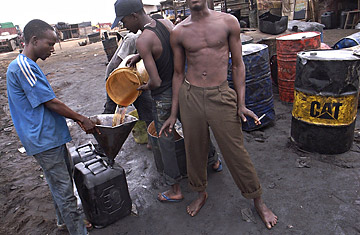
Petrol sellers in Lagos, Nigeria.
(4 of 5)
Containing the people's anger at Nigeria's rulers and their unwillingness to share the wealth isn't easy, though. The Delta is now home to several antigovernment, anti-oil-industry militia groups fighting for a cut of the revenues. The biggest and most organized is the Movement for the Emancipation of the Niger Delta (mend), which counts several hundred militants in its ranks. As Pullo, who titles himself General Officer Commanding, mend Camp Five, says: "God has given us everything in the Delta: water, fish, oil. And yet we are suffering. That is our cross." mend recently issued a press release vowing a new campaign of "attacks against creek- and land-based installations around the Delta. Car bombs will be freely utilized. We will share our pain with all Nigerians." Since the election, mend has kidnapped a score of foreign oil workers and launched several bomb attacks. In an interview with Time, Yar'Adua acknowledged the seriousness of the Delta's security worries. "Yes, the situation in that region is very troubling," he says. "It is obviously one of the issues that will define my presidency, and I would like to resolve it as soon as possible, once and for all."
The violence has reverberations far beyond Nigeria. Oil rose above $50 a barrel for the first time when in 2004 a Nigerian Muslim militant threatened to attack the industry, while fears that the April 2007 elections would trigger renewed violence were a factor in driving the price above $66 in late May. Yergin, of Cambridge Energy Reasearch Associates, warns: "As West Africa becomes increasingly important, consumers in the U.S., Europe and Asia will discover that their own energy security depends in part on political and economic stability in West Africa." American warships already patrol off West Africa, and U.S. energy and security experts have repeatedly called for a permanent military base in the region, possibly on São Tomé and Principe. The American diplomat is dismissive. "The notion that we're going to build a base on São Tomé, like Guantánamo or Diego Garcia, is unrealistic," he says, but he adds that the U.S. is talking to several countries around the region about a permanent U.S. naval presence. The formation of Africom, a separate African command that's currently based in Germany, is another sign of Washington's increased focus on security in West Africa. "The question," says the diplomat, "is how do you secure these shipping lanes, these oil platforms, in an area where the Africans themselves acknowledge they are virtually incapable of controlling their own coasts?"
Gabon: The Thrill Has Gone
So what happens when the wells start to run dry? Look at Gabon.
At a hypermarket in downtown Libreville, a box of eggs from France costs $11, a small bunch of carrots $10, and a bottle of St. Emilion Château Ausone 1er Grand Cru Classé 1999 goes for $312. But it's a short drive from here to Mindwube I, the smoking mountains of garbage on the capital's eastern edge, where the hypermarkets throw out meat and vegetables that have passed their sell-by dates. Madeleine, a 60-year-old mother of 10, lives with several thousand others in the area around the dump. When the truck arrives, it's a ferocious feast. Hundreds of scavengers descend on the skip, elbowing their way into the trash and plunging their hands in deep. "The supermarkets are the best," says Madeleine. "It's in boxes, all arranged." Nor do the inhabitants of Mindwube just find food. There are "plates, dresses, jewelry, liqueurs, TVs, dvds, fridges, children's toys and mobile phones," says André Boussougou, 40. His specialty is aluminum, which he sorts and sells to a pot manufacturer, and leather, which he hawks to a dealer who exports to Europe. "It's really two worlds in Gabon," says Ernst & Young's Watremez. "Rich, poor. There's nothing in the middle."
Gabon is at the beginning of the end of its life as an oil producer. Without new finds, output is expected — optimistically — to halve in the next 20 years and stop in 30. And oil's legacy? A country that ranks 124th on the human-development index, but where Hummer and BMW dealerships thrive. Libreville itself has ranked among the Top 10 most expensive cities in the world for most of the past 20 years. But beyond these privileged circles, there is little evidence of a trickle-down effect. Opposition leader Pierre Mamboundou says his party, the Gabonese People's Union, figures that 15,000 people in Gabon hold 80% of the nation's wealth.
Even in a country that is four-fifths rain forest and has coastal waters full of fish, the government — which didn't respond to repeated interview requests — appears to lack a compelling vision of what industries might take over where oil leaves off. There is the additional economic burden of importing nearly all of the country's food from Europe. Entrepreneurial spirit has all but evaporated: while rich Gabonese may fund new businesses, most are set up and run by Europeans. And the nation is afflicted by a widespread sense of moral degeneration — from bureaucratic corruption to petty theft to sexual violence. "The lack of standards shown by Gabon's leadership has generated a complete immorality in the country," says a European economist in Gabon. "That's the real curse of oil."