

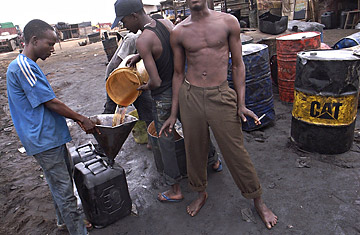
Petrol sellers in Lagos, Nigeria.
(3 of 5)
Angola is following a path that's painfully familiar among African oil states from Equatorial Guinea to Sudan. The pattern is this: well-connected businessmen and unscrupulous government officials grow impossibly rich, and the ruling élite uses its wealth and largesse to consolidate its own power. Much of this money is funneled into banks and assets abroad, while the majority of the population stagnates or even grows poorer.
In Angola, the government collected $10 billion in oil revenues in 2005 alone, and that number is expected to soar until production peaks in 2011. This is the first gusher of wealth in a country that has never known it. But the gains are not evenly spread. In downtown Luanda today, it's clear Angola's new rich are doing well. In April, the $35 million Belas Shopping Center — the country's first mall — opened in a new suburb called Nova Vida. There, in a store called Tapazio, they can shop for such baubles as silver-plated ashtrays and a $7,000 candelabra. Yet 70% of Angolans still live below the country's poverty line. Cholera and malaria are rife, and child mortality rates are among the worst in the world. A kilometer away from Nova Vida, in the shanty town of Cambamba, children play in open sewers, and piles of burning garbage shroud shacks in foul-smelling clouds of smoke. As Valdemir puts it: "The rich use mineral water. For us there is no water. No electricity or sanitation either."
What's next for Angola? As in other parts of Africa, oil will no doubt continue to dominate the economy. It currently accounts for around 90% of all exports, compared with 77% in Gabon and 95% in Nigeria. The second stage of the oil curse kicks in at this point. Investment in other industries gets crowded out, in part because it's hard for them to provide high enough returns to meet the costs of rising rents and salaries. Oil becomes virtually the only game in town, and the benefit to workers is surprisingly limited, with many of the more lucrative jobs — such as rig operator and refinery manager — going to foreign experts. Hence the expat enclaves in oil towns from Port Gentil to Baku. In some cases, unemployment can actually worsen. Fueled by the new spending power of the few, the cost of living also goes up. If the government doesn't share the wealth, the higher prices mean real poverty actually rises. And in Angola there's little evidence of government sharing: a 2004 Human Rights Watch report claimed that $4.22 billion in oil revenues went missing between 1997 and 2002.
Nigeria: Wretched Excess
Tom Pullo looks like a fighter. His chest is a barrel, his forearms are all muscle. Seeing him at breakfast at the Agura Hotel in Nigeria's capital, Abuja, a place favored by foreign oil executives, you might take him for a security guard protecting his charges. But Pullo works for the other side. "We are not taking hostages because of money," he says. "We are taking hostages to draw world attention to our plight." Nigeria is the oil giant of Africa. It is also, as an American diplomat in the region says, "one big problem."
Nigeria pumped its first barrel in the 1950s and has since set records for corruption. The government's own anticorruption watchdog, the Economic and Financial Crimes Commission, estimates that between independence in 1960 and 1999, the country's rulers stole $400 billion in oil revenues — equal to all the foreign aid to Africa during the same period. And while a small élite became rich, its members fought one another for the spoils. In 47 years, Nigeria has suffered a civil war that killed a million people, 30 years of military rule and six coups. Meanwhile, two-thirds of the country's 135 million people remain in poverty, a third are illiterate and 40% have no safe water supply. Then there is the environmental cost: more than 1.5 million tons of oil have been spilled over 50 years, and the Niger Delta is one of the most polluted places on earth.
Not surprisingly, disenchantment with the nation's political leaders runs deep. Nigeria has been a nominal democracy since 1999. But international monitors have questioned the fairness of the April 21 elections in which outgoing President Olusegun Obasanjo was replaced by his favored candidate Umaru Yar'Adua, a previously obscure state Governor. "These elections have not lived up to the hopes and expectations of the Nigerian people, and the process cannot be considered to have been credible," said Max van den Berg, chief E.U. observer, after the vote. When Yar'Adua was sworn in as President last Tuesday, he vowed to improve the election process and "intensify the war against corruption," while also pleading with "aggrieved" Nigerians to "suspend all violent activities and respect the law."