

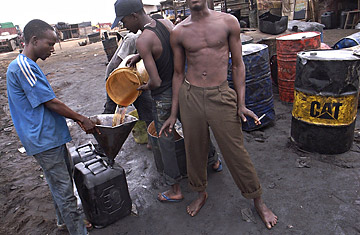
Petrol sellers in Lagos, Nigeria.
Right now, one of the busiest spots on the oil map of the world is Club Tropicana. Owned by a genial 45-year-old named Aguinaldo Salvaterra, the Tropicana is tucked behind the grand pink and blue Portuguese town houses that line the seafront of São Tomé. It's a little poky, but the beer is cold and, crucially in a town that rises late, enjoys a siesta and retires at dusk, Salvaterra rarely leaves his stool, which means the Tropicana is the one place in São Tomé that's nearly always open. Lately, that has made it the venue of choice for a new kind of customer. "British riggers, Scandinavian geologists, Japanese diplomats, you name it," says Salvaterra. "You just missed a big-time Nigerian oilman." He nods at the room and rubs his thumb against his forefingers. "Those tables are seeing some deals."
Seismic tests have suggested that São Tomé and Principe, two tropical rocks off the coast of West Africa with a population of 199,000, might be sitting on billions of barrels of oil. For the last few years, the islands have been buzzing with the hope that it will make millionaires of them all and transform a nation where the average annual income is $390. "This is a very poor country," says Luis Alberto Praxeres, executive director of São Tomé's National Petrol Agency. "Oil could solve all our problems."
It hasn't done so yet. In January this year, Chevron said it had not found enough oil to make a well economically viable at the first of its two drill sites off São Tomé. Exxon Mobil, too, has said that it will not, for now, be pursuing exploration off the island, though it retains its drilling rights there. Praxeres, however, still dreams his dreams, and his little country continues to attract a stream of oil-fevered visitors from overseas: this year alone, officials have arrived from the U.S., the U.K., Germany and Japan. But even if São Tomé and Principe were sitting on as much oil as Saudi Arabia, there would be no guarantee that the black gold would deliver happiness and prosperity to its people. On the contrary, if history is any guide, vast caches of oil can cause developing nations as many problems as they solve.
São Tomé and Principe is part of a string of countries on the Gulf of Guinea, the right angle in Africa's west coast, which is the oil industry's new El Dorado. By some estimates, Africa holds 10% of the world's reserves, but that figure belies the importance West Africa has already achieved as a source of energy. According to Poisoned Wells, a new book on African oil by Nicholas Shaxson, an associate fellow with international affairs institute Chatham House in London, the U.S. imported more oil from Africa than from the Middle East in 2005, and more from the Gulf of Guinea than from Saudi Arabia and Kuwait combined. Nigeria, the giant of the region, supplies 10-12% of U.S. oil imports. "There's a huge boom across the region," says Erik Watremez, a Gabon-based oil and gas specialist for Ernst & Young. "Exploration, drilling, rigs, pipes. It's exploding." Ann Pickard, Shell's regional executive vice president for Africa, agrees: "The Gulf of Guinea is an increasingly important place."
Indeed, says Daniel Yergin, chairman of Cambridge Energy Research Associates, West Africa is "only going to get hotter. It has the location and the resources; the technology is now there to develop them; and companies from all over the world want to be in on the action." Rising demand from India and China and worries over instability in the Middle East have fueled higher oil prices, and those in turn have precipitated a new scramble for energy — oil rigs worldwide now have to be rented a year in advance. There are several reasons why the Gulf of Guinea is a key focus of this rush. African oil is high quality, with a low sulfur content that requires little refining to get it to the pump. The Gulf is relatively close to the U.S., cutting shipping costs to the world's biggest oil consumer, and most of the reserves are out to sea — which means there's no need to construct pipelines through different nations to get the stuff to market. Equally important: unlike some other oil-rich countries, African nations welcome foreign companies to their oil fields, as there are no indigenous African oil majors. In his 2007 book Untapped: The Scramble for Africa's Oil, John Ghazvinian, a visiting fellow at the University of Pennsylvania, explains the euphoria like this: "African oil is cheaper, safer and more accessible, and there seems to be more of it every day ... No one really knows just how much oil might be there, since no one's ever really bothered to check."