

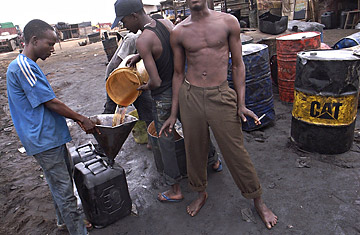
Petrol sellers in Lagos, Nigeria.
(2 of 5)
Security is a crucial part of the attraction. West Africa may have a history of political instability, but most of its oil is offshore, and the assets of international companies have so far not been prone to the sort of nationalist expropriation common in oil's history from Mexico in the 1930s to Russia today. And although there have been attacks on oil installations in Nigeria, the region does not experience the sort of out-of-control violence that now plagues Iraq. Such factors make "West Africa of great interest and great significance," says a senior American diplomat in the region. In fact, five years ago the U.S. State Department declared West African oil a "strategic national interest."
The National Intelligence Council, a U.S.-government think tank, predicts that the Gulf of Guinea will supply 20-25% of total U.S. imports by 2020, but Americans are not alone in their mounting dependence upon West Africa. Angola is now China's top oil supplier. Gabon is a key supplier of France. Oilmen from countries as diverse as Russia, Japan and India are showing up in places like Equatorial Guinea, Cameroon, Chad — even perennial war zones like the Democratic Republic of Congo. With all that interest, Paul Lubeck, Michael Watts and Ronnie Lipshutz of the Center for International Policy, a U.S. think tank, calculate that the Gulf of Guinea will earn $1 trillion from oil by 2020 if the price stays above $50 a barrel. That's roughly double all the post-colonial aid to Africa since independence in the 1950s and 1960s.
That should be good news for some of the poorest countries in the world's poorest continent. After all, Norway and Britain used North Sea oil to underwrite their welfare states, while small oil powers like Oman and Brunei found themselves catapulted out of subsistence living in a generation. Likewise, Alberta's burgeoning petroleum industry has transformed the province into a major driver of the Canadian economy. But oil is not always a boon. What if it fuels corruption rather than development, and creates the same combustible mix of great wealth, relative poverty, grievance and instability as it has in the Middle East? Economists often talk of the "curse of oil," pointing out that countries with resources such as oil often grow more slowly, more corruptly, less equitably, more violently and with more authoritarian governments than others do. The authors of Escaping the Resource Curse — Jeffrey Sachs, Joseph Stiglitz and Macartan Humphreys — assert that there is "a strong association between resource wealth and the likelihood of weak democratic development, corruption and civil war." Western oil workers in the Middle East lived in secure compounds with armed guards long before hijackers hit the Twin Towers. Is that same pattern developing in the Niger Delta today, where they also live in guarded compounds after the kidnap of more than 200 workers in the last two years?
To answer that question, consider the experience of three countries: Angola, Nigeria and Gabon. The oil industries in each are at markedly different stages. Angola's is in its first explosive flush of production, with gdp expected to grow 27% this year. Nigeria is in its prime, ranking as the world's 12th largest producer in 2006. Gabon's wells are slowly drying up. Together, these three nations trace an evolving arc of oil's effect on Africa and the world, of both its promise and its perils.
Angola: Out of the Ashes
When 27 years of civil war ended in Angola in 2002, Luanda was anything but a boomtown. Bombed out and rubbish strewn, the capital was — and still is — home to one of Africa's biggest slums. Five years later, the pace of growth is best measured by the island of Mussulu, a former fisherman's village off Luanda. Today Mussulu is a playground for Angola's new oil oligarchs. Its white shoreline, 10 minutes south of Luanda's new yacht club, is teeming with power boats and jet skis. "That guy likes to bring people here in his helicopter," says Valdemir, a fisherman, pointing to the house of a local tycoon.
The world had known about Angola's oil reserves for decades, but war made them hard to reach. Now peace and high prices have made them alluring again. Today Angola is the second-largest oil producer in sub-Saharan Africa, and production is growing 25% a year. Since 2002, businessmen have been flying into Luanda offering huge sums in return for access to oil, while foreign governments have bolstered their case with aid. China has made a habit of outbidding the world here. In 2004, years of talks over structural reforms between Angola and the International Monetary Fund became redundant when a state-run Chinese bank offered a $2 billion line of credit without any such requirements for reform. In 2005 and 2006, the Chinese announced loans worth an additional $3 billion.