

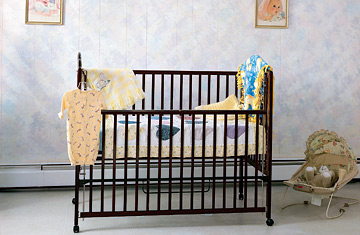
Asheville Pregnancy Support Services often gives baby gear to women who feel they can't afford to raise a child.
(6 of 9)
And now the conversation gets more complicated, as information and ideology conjoin. If a woman is "abortion minded," Wilson says, "then we go over the medical risks--and there's research for this, even though the other side says there's not." She ticks off grim possibilities with fervor: "The research is that breast cancer is more prevalent. You have the rupture of the uterus. Infection is major. The risk of ectopic pregnancy is greater later on." It is this discussion of risk that most enrages defenders of abortion rights, especially doctors who routinely see terrified women who come in for an abortion after hearing such warnings and ask over and over, "Am I going to die?"
Despite restricted access, abortion remains one of the most common surgical procedures in the U.S. for women and, according to the Guttmacher Institute, fewer than 0.3% of patients experience a complication serious enough to require hospitalization. First-trimester abortions in particular are considered extremely safe. After years of debate about breast cancer and abortion, the U.S. National Cancer Institute in February 2003 gathered the world's leading experts to review the data and assess the risk. They stated that their conclusion that "induced abortion is not associated with an increase in breast cancer risk"was "well established," the institute's highest rating for research findings.
But none of that convinces Wilson. "It's a money issue," she says of the studies rejecting a breast-cancer risk. "The abortion people have a lot of money. If there's a study, I want to know who's sponsoring it because nine times out of 10, it's skewed to the money." It's hard to imagine what it would take--certainly not a ruling from the U.S. National Cancer Institute--to change her mind.
Locals describe Asheville as "half Christian, half New Age," a town where Baptists preach about Jesus' saving grace while mystics talk about the vortex entrance panels tucked in the mountains. There are a great many churches and Presbyterian summer camps here in Billy Graham's backyard, but there is also a lively population of retirees and artists and entrepreneurs opening craft shops and microbreweries. It thinks of itself as a tolerant town--to the point that the only facility in all of western North Carolina that publicly offers abortions is the city's Femcare clinic. It has a fence around it, cameras, alarms and a security guard because it was bombed in 1999 and had its windows shot out in 2003. "It really tested me," says Lorrie, the clinic's sole abortion provider, who, given past threats, prefers that her full name not be used. "If I didn't continue, the place would close. No one wants to go into abortion providing. But it's so important. I know that I'm providing a service to women that no one else will."