

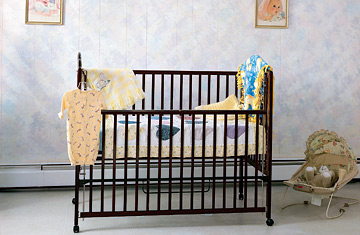
Asheville Pregnancy Support Services often gives baby gear to women who feel they can't afford to raise a child.
(5 of 9)
But pressure can take many forms, and the experience of a NARAL investigator suggests that manipulation may be in the eye of the beholder. Courtney Barbour, an administrative assistant at the University of North Carolina at Chapel Hill, arranged to pick up the urine of a pregnant woman on her way to Birthchoice, a CPC in nearby Raleigh, so she would test positive and see the reaction. Having heard horror stories from friends in college, she was braced for the worst. "But it really wasn't what I expected," Barbour says. "They acted like they really did want to help me." While one woman handled the pregnancy test, Barbour spoke to a counselor who was very sympathetic. "She didn't show me any disgusting movies--though she did show me these plastic models of the fetus at each stage of development--and told me that it has a heartbeat immediately, which I knew medically was not true." The counselor asked about her resources, her family and her intentions. "She didn't actually prod me in any particular direction," Barbour says. "She was just listening to me, nodding her head. She wanted to know if my family was religious, and I told her, well, I don't go to church, but my grandfather was a Methodist minister. She didn't act really judgmental or anything. She did say, 'Well, I bet that your grandfather really would like you to have this baby.'"
Eventually the woman who had done the test reappeared, holding a pair of soft blue, hand-knit baby booties. "Congratulations!" she said. "You're a mother."
How you classify that encounter says a lot about your politics: one person's loving support is another's emotional pressure. "They talk about the joys of childbirth, which can certainly be a joy," says Melissa Reed, executive director of NARAL's North Carolina chapter, "but they can make a woman feel very intimidated about making any other choice in her life." Wood insists that at her center counselors are trained not to push. "We don't hand out baby booties to everyone with a positive pregnancy test," she says. "We don't do emotional blackmail." And her center at least continues to provide support through the first year of a baby's life. But Wood's priority has been to move away from general maternal help and focus on "abortion vulnerable" women, which is to say, any woman facing an unplanned pregnancy who might entertain abortion as an option.
The ultrasound machine arrived at the Asheville center last summer, thanks to funding from Focus on the Family's Option Ultrasound initiative ("Revealing Life, to Save Life"). Nurse Wilson and her colleague Denise Bagby had two weeks of intensive training in "limited obstetrical ultrasound," practicing on pregnant women recruited from local doctors' offices and churches and by word of mouth. They learned how to confirm and date a pregnancy and measure a fetus--but not how to diagnose fetal abnormality. Two medical directors sign off on every report. "We're not giving medical care," Wood insists, although she stresses the value of early ultrasound in helping persuade women to quit smoking, eat better, get prenatal care and come to grips with what is happening inside their bodies. "I can't tell you how many women we see who have had an abortion in the past who all say the same thing," Wood says. "'If only someone had told me. If only I had someone to talk to.'"