

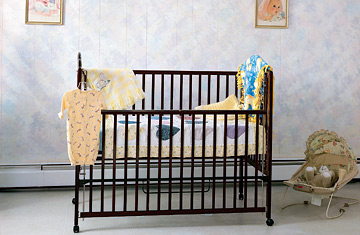
Asheville Pregnancy Support Services often gives baby gear to women who feel they can't afford to raise a child.
(4 of 9)
There's such momentum behind the CPC movement that abortion-rights groups have begun to fight back. Last summer the U.S. National Abortion Federation published a study on the centers subtitled An Affront to Choice, which charged them with marketing themselves so that women looking for a full-service health clinic might mistakenly go to a CPC instead and be "harassed, bullied and given blatantly false information." It accused centers of focusing on women's needs through the first two trimesters but then abandoning them once obtaining an abortion becomes much more difficult. Los Angeles Democrat Henry Waxman, now chairman of the House Committee on Oversight and Government Reform, investigated federally funded CPCs, using callers posing as pregnant 17-year-olds. The investigators reported that 20 of 23 centers they reached provided "false or misleading information about the health effects of abortion," inflating the risk of breast cancer, infertility, depression and suicide.
The heat of the national battle, however, doesn't capture what is happening on the front lines. In North Carolina, Abortion Clinics OnLine lists eight abortion providers, but the state has more than 70 pregnancy centers. NARAL Pro-Choice North Carolina was so concerned about their practices that it recruited volunteers to call centers and record the information they were given. NARAL reported that in the course of promoting abstinence, a counselor told an investigator that "all condoms are defective and have slots and holes in them." Another warned that "9 out of 10 couples that go through an abortion split up."
Wood hears these stories of undercover reconnaissance missions and just shakes her head. "It's about discrediting our centers," she says flatly, but she welcomes anyone who wants to call hers. Everyone gets the same information, and she's confident that it's accurate: "They can come after us all they want--it won't change what we're trying to do." What they're trying to do, she says, is prevent a frightened pregnant woman from making a rash decision that she may come to regret. You can talk about choice all you like, she argues, but if a woman feels overwhelmed and all alone and thinks she can somehow "turn back the clock like the pregnancy never happened," then she doesn't understand what abortion really entails. "We need to counter the message that abortion won't have any consequences," she says. "That's unrealistic. All decisions have consequences."
She tells her counselors to tread gently. You don't need to lie or bully, she says--just listen and love: "We understand completely that this is her decision." The waiting room is not full of baby pictures, she notes, and the counseling room is no place for political debates. "We don't want a zealot in there," she says. "We want someone who's going in there with a heart and compassion who'll talk reasonably and present the options." And, she adds, she would never, ever show graphic pictures or movies like The Silent Scream, the landmark 1984 video that presents an abortion being performed in which the fetus is portrayed as crying in pain. The women who come through her door, Wood says, "are traumatized enough already. Why would we do that? We're trying to be caretakers. I know how I'd respond if somebody did this in-your-face thing to me. I'd pull back. It's ineffective ... so why do it?"