

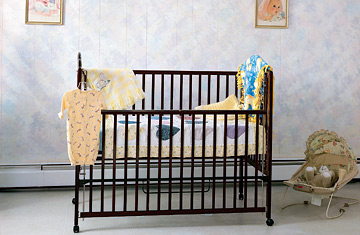
Asheville Pregnancy Support Services often gives baby gear to women who feel they can't afford to raise a child.
(2 of 9)
Crisis pregnancy centers (CPCS, now often called pregnancy resource centers) have been around for a few decades, but the Bush Administration has made them a centerpiece of compassionate conservatism, a signal to members of the President's evangelical base that he shares their values. But as a new presidential race looms, the signals may be shifting, the rancor of the public fight fading. Hillary Clinton has called abortion "a sad, even tragic choice to many, many women" and talks about improving education and access to birth control so that abortion becomes a right most women never have to exercise. On the Republican side, Rudy Giuliani is pro-choice, Mitt Romney used to be, and John McCain's pro-life record doesn't keep social conservatives from viewing him with some suspicion. Other issues, whether war and peace or gay marriage and stem cells, may be the prime motivators in this election; and in the meantime, pro-choice Democrats are back in control of Congress. "The power change in Washington highlights the increasingly strategic role pregnancy centers play in the pro-life movement," says Kurt Entsminger, president of Care Net, the largest pregnancy-center network. With abortion-rights advocates now in leadership positions, "pro-life legislative advances will inevitably be shut down."
The centers are typically Christian charities, often under the umbrella of one of three national groups: Care Net, Heartbeat International and the U.S. National Institute of Family and Life Advocates. No one can say precisely how many pregnancy centers there are, since some aren't affiliated with any national group. Care Net puts the figure at around 2,300, though that does not include traditional maternity homes, adoption agencies or Catholic Charities. Care Net and Heartbeat International also operate Option Line, a 24/7 call center based in Columbus, Ohio, that women can contact for information and referral to a CPC near them. Last year Care Net spent $4 million on marketing, including more than $2 million on billboards alone (PREGNANT AND SCARED? 1-800-395-HELP. WE'RE HERE 24/7). The Internet has become a tool for outreach as well. Care Net has got into bidding wars with abortion providers over who would receive top placement in the sponsored-links sections on Yahoo! and Google when someone searches for abortion.
In the past 10 years, as public funding for family planning has stalled, unplanned pregnancy rates have jumped 29% among poor women; they are now more than four times as likely to have abortions as richer ones. Pregnancy centers offer everything from emergency food and formula to strollers and baby clothes to help with the month's rent. "We're willing to offer $200, $300, $400 on the spot, no strings attached," says Pat Foley, who runs the Wakota Life Care Center in St. Paul, Minnesota. "No life should end because of money." While no one disagrees with that, some do wonder how much help will be available for these families in the years to come, with school, housing and health care, since according to the Guttmacher Institute, 3 out of 4 women contemplating abortion cite economic pressure as a reason.