

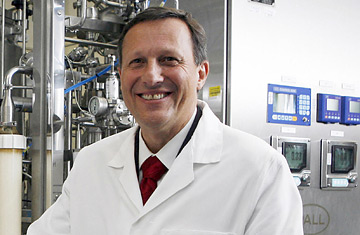
Novartis chairman Daniel Vasella
(5 of 7)
Vasella keeps a keen eye on his cherished drug business from an elegant second-floor office in the old Sandoz headquarters. On a counter behind his black leather chair are a pair of ancient Egyptian vases, a sword from the Han dynasty and a large blue-green bust of Buddha from the Tang dynasty. An avid collector of Oriental art, he recently bought a 13th century Tibetan statue of Buddha made of gilded bronze, which he keeps at his home in Zug. "I talk to him sometimes," says Vasella, "and I say, 'You know, I like you better than Jesus.'" Vasella swims two or three times a week and likes to target shoot on the rare occasion when he can make it to the range. He enjoys walking his Rottweiler and bullterrier and riding his BMW and Harley-Davidson motorcycles over the hilly terrain around Zug. Vacations are precious--a chance to spend time with his wife, his 18-year-old daughter and his 14- and 10-year-old sons.
At work and at play, Vasella is a fierce competitor. "Doing it better than the others" is what excites him, he says. "Screw them, in a sense." He spends about a third of his workdays traveling around Europe, Asia and the Americas. The rest of the time, he is usually in back-to-back meetings with managers. "He challenges us," says John Manser, Novartis' treasurer, who meets with Vasella once a month to discuss the firm's investments. "He wants to know what sectors, what stocks--he goes to that level." Notes another top manager: "He's not a patient guy. He won't sit with you for 15 minutes as you carefully explain something. He wants to know the facts, and you better have them down cold."
The research strategy at Novartis is among the most productive in the industry. It invests 17% of drug sales in pharmaceutical R. and D., or $2 billion annually. Thanks to innovations in technology and management, Novartis carries its drugs through development in only two-thirds the time it takes the average drug company. Its tightly coordinated R.-and-D. and marketing efforts focus on areas, such as cardiovascular diseases, in which treatments are judged to offer the greatest potential for profit. Senior vice president for business development Paul Sekhri, who helped pick these areas by going systematically through some 980 categories of ailments, says Vasella took a keen interest in how they were chosen. But while Vasella has taken aim at larger markets, he has ensured that more specialized products, such as ophthalmologic drugs, are not neglected. If there is enough of an unmet medical need, they too can be enormously profitable. David Epstein, head of Novartis' oncology unit, observes that a drug that works well on a limited population can build its market over time simply by keeping its users alive.
Such drugs can also have other applications. That's what guides Novartis' continuing research on Gleevec, a revolutionary drug initially directed against a rare leukemia. Responding to petitions from patients, Vasella pushed to complete clinical trials of the drug in just 32 months. It was recently approved to treat a second rare cancer that affects the stomach. Now Novartis is evaluating its effects in combination with other drugs on more common cancers, such as those of the prostate.