

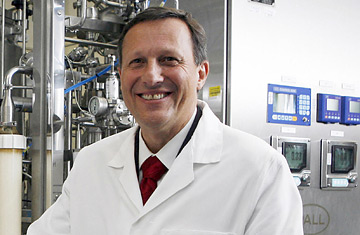
Novartis chairman Daniel Vasella
(3 of 7)
At 34 he was a trainee--but one with a rocket strapped to his back. A year after joining Sandoz, Vasella became product manager for a new drug named Sandostatin, approved to treat a rare pancreatic cancer. The head of Sandoz's U.S. pharmaceutical unit joked that Vasella could consider his job well done if he made Sandostatin a $5 million product, a pittance in the branded-drug business. Vasella realized that to make Sandostatin a commercial success, he had to find new uses for it. And he believed he could do that only by radically changing the game.
At Sandoz, as at most pharmaceutical companies in those days, new products came to market through a linear, three-step sequence. Researchers would seek out potential drugs. Development teams would test and refine them in hopes of winning regulatory approval. Finally, marketers would peddle the approved drugs to physicians. These steps were typically conducted in isolation, so developers would sometimes find out too late that a candidate drug had terrible side effects or could not be mass-produced economically. Or marketers would discover late in the process that there wasn't much demand for the new drug they would soon be asked to sell.
Vasella changed all that. He had clinical researchers, chemists from production and marketing managers put their heads together to find profitable new uses for Sandostatin. Those exertions paid off. The drug won approval for treating the side effects of certain cancers, and sales rose rapidly, reaching $486 million last year. Vasella asked Kim Clark, then a Harvard Business School professor (and now dean), to sign on as a consultant. "He told me something that stuck in my mind," says Vasella. "He said, 'You can change an organization from top down or bottom up, but it's very hard to change it from the middle.' I was a middle manager."
But not for long. In 1993 Vasella returned to Switzerland to head corporate marketing at Sandoz headquarters in Basel. The next year he briefly led the company's global drug-development programs, and he was its chief operating officer before becoming CEO of its drug business, reporting to the chairman of the conglomerate, Marc Moret--his wife's uncle. Vasella applied the lessons he had learned while managing Sandostatin to all the company's drug-development efforts. When Sandoz announced in 1996 that it would merge with its rival across the Rhine, Ciba-Geigy, Vasella was named CEO of the new company.
Basel is in some ways the Houston of Switzerland: one industry overshadows all the others, and the zoning is haphazard. In Basel it isn't unusual to see a modern glass-and-steel monstrosity amid a row of elegant 19th century neoclassical buildings. The Rhine plies a serpentine course through the city, and Novartis' headquarters are at the river's edge, at a point where France, Germany and Switzerland meet. Across the Rhine from Novartis and a little to the east, marked by a tall white smokestack, is rival Roche. The pharmaceutical execs in Basel know one another, and they talk.
In this environment, Vasella had something to prove. His family ties to Moret had provoked dark mutterings of nepotism, especially in light of his rapid rise. But that was unfair, says SG Cowen analyst Peter Laing. "To anyone who followed the company at the time, Dan was the live wire. He had the most international outlook, and there really wasn't anyone at Ciba to challenge him."