

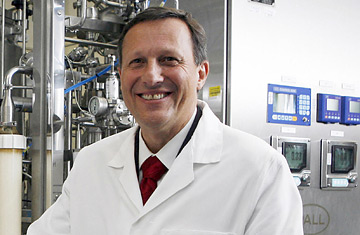
Novartis chairman Daniel Vasella
(2 of 7)
Its secret? An aggressive expansion in the U.S. and an innovative approach to R. and D. Novartis has launched nine groundbreaking drugs since 2000--three times as many as its nearest competitor--and plans to launch 12 more by 2006. The company's relatively low debt and ample cash reserves have earned it a credit rating of AAA from Moody's. Morningstar analyst Todd Lebor praises the company's "excellent financial disclosure and conservative accounting" and notes that it has no unconsolidated debt. Pfizer's announcement last week that it will merge with Pharmacia sent several drugmakers looking for partners. But while Vasella doesn't rule out an acquisition, his firm is considered one of the few strong enough to succeed on their own.
Vasella knows, though, that he can't insulate Novartis from the rising public rebellion against drug prices. According to the advocacy group Families USA, prices of such branded drugs as Novartis' Miacalcin and AstraZeneca's Prilosec have grown at twice the rate of inflation, even as government controls have kept the same prescriptions much cheaper in most other countries. Patients in the U.S.--who account for roughly half the drug industry's annual global revenues of $364 billion--are howling, and they are getting heard in Congress. But so is Vasella, who employs 19,000 Americans and recently opened a $250 million research facility in Cambridge, Mass. He routinely meets with U.S. lawmakers and regulators. Among drug-company CEOs, he has taken the lead in giving a little on prices to avert sweeping new regulations.
Vasella came late to the business world but was introduced early to illness and adversity. Born in 1953 in Fribourg, Switzerland, the son of a history professor and the youngest of four children in a Catholic household, Vasella developed asthma at 5, then fell ill with tuberculosis and meningitis at 8, each time spending a year away from home in recovery. He was 10 when his eldest sister died of cancer; three years later, his father died from complications after surgery. But the accidental death in 1982 of his second sister, who had attended medical school with him, was most painful. "That was somehow unreal," he recalls. "When I was young, I thought that the sum of mishappenings in our lives is constant, that there must be some kind of balancing justice."
After marrying his high school sweetheart in 1978 and completing medical school and a string of residencies, Vasella started as an attending physician at a university hospital in Bern in 1984. Though he loved working closely with patients, it bothered him that he knew little about business, especially because he had begun to invest modestly in stocks. Four years of psychoanalysis, Vasella says, helped free him "from the rules and obligations one imposes on oneself" and give him the courage to leap into a new career. In 1987 he sought the advice of Max Link, the well-connected and accessible head of the drug business for Swiss conglomerate Sandoz. Vasella was offered a job and sent to learn the ropes at the company's headquarters in East Hanover, N.J.