

(4 of 6)
Equally mysterious is why Johnson can identify her pre-encephalitis drawings as her own, despite the fact that she can't identify even the world's most famous paintings except the Mona Lisa. "Whatever it is that allows her to recognize her own style is incredibly complex," says Johns Hopkins cognitive neuroscientist Barbara Landau, who works with Johnson. "I don't think we know how to characterize it."
They also can't explain why Johnson is so fixated on the alphabet. Nearly a year after the encephalitis struck, an acquaintance of Aline's wondered whether Johnson might enjoy doing word-search puzzles, in which hidden words are embedded in random grids of letters. As soon as Johnson got her hands on the books, she devoured them.
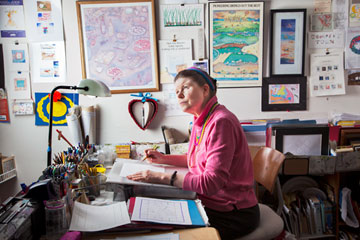
"All these pages, hundreds of pages," Aline recalls, "and when she got to the end, she asked with great urgency, 'What should I do?'" So she began creating her own puzzles, then incorporated the letters and wordplay into her art. Eventually, she had created a portfolio so large and oddly compelling that her artwork, both pre- and post-illness, was featured in exhibitions at Baltimore's Walters Art Museum and at the Morven Museum in Princeton.
Aline is convinced that the alphabet's familiar and immutable sequence has given her sister's life meaning in a world that must otherwise seem completely disjointed. "It makes sense," says Michael McCloskey, another Johns Hopkins neuroscientist on the research team. "It structures her day and gives her something to hang on to."
Music, with its alphabetic and semimathematical structure, might have the same kind of ordering effect the letters do. Johnson retained her ability to play the viola and to read music, both of which involve unconscious memory--sometimes known as procedural or muscle memory. It was unclear, however, whether she could learn a new piece and improve over time. So Emma Gregory, a Johns Hopkins postdoctoral fellow on the research team, recruited a Johns Hopkins undergrad to compose something for Johnson. Then they put one sheet of music after another in front of her, some containing the entire piece, some with just passages. Time after time, Johnson would read the title, "Caprice," aloud and say, "Oh, that's made of cap and rice," solving a mini-word-search puzzle on the fly. Then, inevitably: "What language is that?"
But, says Gregory, "she absolutely did seem to learn the piece." Now the scientists are curious about whether she has retained other skills like driving a car or piloting a plane. Nobody is going to put her in a cockpit and send her flying. "You can go," said Landau, laughing, when the idea came up at a team meeting. "I'll watch from down below." But getting her into a flight simulator is not out of the question.
Ghost in the Machine
Johnson's sessions in the MRI scanner are as informal as the scientists and her family can make them. Princeton's Nicholas Turk-Browne and his colleague Sabine Kastner, an M.D. and a neuroscientist, supervise the work. They spend a few minutes chatting with Aline and Maggi as they make sure Johnson doesn't have anything metal in her pockets; then they use an airport-type security wand to double-check. As the tests progress, the scientists sit in a control room, explaining what they want her to do--and explaining again, with complete patience, when she forgets.