

(3 of 6)
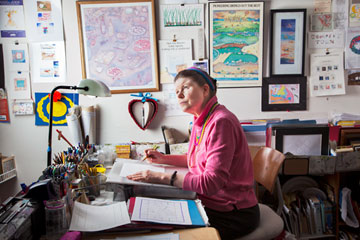
For the next six months or so, the pair followed Johnson from hospital to acute rehabilitation facility to subacute nursing unit, working alongside therapists to teach her how to walk again, talk again, feed herself. Over those long months, they also pushed her to resume drawing, one step at a time. "She could barely draw a line on her own for the first few months," says Aline. "So my mother invented games, such as drawing a shape and having Lonni Sue copy it."
It was no wonder Johnson was struggling so much. Brain scans revealed that her encephalitis had effectively destroyed her hippocampi, a pair of sea-horse-shaped structures deep in the brain's basement. It also did extensive damage to structures surrounding the hippocampus, including areas known as the perirhinal cortex and the parahippocampal cortex. That was very bad news since the job of the hippocampus is to consolidate short-term memories into permanent, long-term ones. If the hippocampus isn't there to do that work, everything starts over every few minutes.
The reason, explains Larry Squire, a professor of psychiatry at the University of California at San Diego, is that what seems like a single memory is actually many memories in different parts of the brain. The recollections you have of last year's Thanksgiving dinner, for example, consist of sights and sounds and smells and tastes and deeper links to the people who were there, all of which are processed in different parts of the brain. It's the job of the hippocampus to act like the attentive host at a party making introductions among all those parts. "It's a common mistake to think that memories are initially in the hippocampus and then get shipped somewhere," says Squire. "They're never shipped. They're always somewhere else."
Given how small and tightly packed the brain's multiple structures are, a tiny bit of greater or lesser damage in any direction around a central lesion can have a powerful impact. Molaison had trouble retrieving memories of things he did leading up to his surgery, but he could easily call up cold facts--so-called declarative information--from his childhood, such as what town he came from and where he went to high school and who President Roosevelt was. For Johnson, these kinds of details have been lost. She recalls the layout of her childhood home and the name of her street and the fact that she used to fly a small plane--and little else. The difference may have to do with the damage to her perirhinal and parahippocampal cortices. Molaison suffered only partial loss of the former; Johnson has almost certainly lost significant parts of both.
The Long Crawl Back
The slow recovery Johnson has made offers other clues about how memory works. Months after she started painstakingly copying lines, Johnson began sketching without help. Eventually, says Aline, "the little people came back." Tiny human figures had been a hallmark of Johnson's pre-amnesia art. "It was one of the first indications that those images were still inside her head. If it weren't for the art, how would we know they were there?" But exactly where they'd been hiding or how they were flushed out remain unclear.