

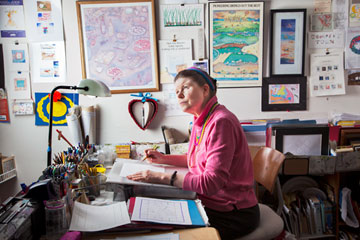
When you first meet Lonni Sue Johnson, it takes a few moments to realize that something isn't quite right.
"Hello!" she says brightly, looking up in surprise, with an expression of pure delight on her face. "Would you like to see my drawings?" Her glee seems strangely childlike for a woman in her early 60s; she's just a little happier to see you than feels appropriate, given that you're a complete stranger. You might think for a moment that she suffers from an intellectual disability--what used to be called mental retardation.
But then she shows you the drawings. They're complex and finely executed, and they feature elaborate visual puns. She's obviously got a lively intelligence. The only odd note in the artwork--stacks upon stacks of it--is that it tends to be richly decorated with letters of the alphabet and often includes lists of words, all beginning with the same letter or with letters in alphabetical order. You might be tempted to place her on the autism spectrum. But that makes no sense either, given the open joy she displays at connecting with people.
Leave the room for a moment and come back, however, and things become clear. "Hello!" she says brightly, as though she's never seen you before. "Would you like to see my drawings?" And if you leave again and return once more, she'll greet you the same way. Because as far as she knows, she never has seen you before.
Johnson is profoundly amnesiac. She's essentially unable to form new memories: some experiences are gone in seconds, others in minutes, but next to nothing endures. She can't bring up many old memories either. She recalls few episodes from her life and has little general knowledge about the world. She was in eighth grade when John F. Kennedy was shot, but if you show her a picture of him, all she knows is that he was a President.
Such cases of annihilated memory are very rare. Some are caused by traumatic brain injury; others, like Johnson's, are the result of viral encephalitis, which often kills its victims or leaves them comatose. But they're also extraordinarily valuable: by looking at how illness or injury robs people of memory, neuroscientists have an opportunity to gain insights into how it works when all is well.
For that reason, a team of scientists from Johns Hopkins and Princeton universities have been studying Johnson for the past four years, ramping up their efforts dramatically in the past two and recently submitting for publication the first of what will be many papers on her that will continue for the rest of her life. Once a month or so, the researchers show up at Johnson's mother's house in Princeton, N.J., or bring her to the brain-imaging center at the Princeton Neuroscience Institute for a battery of tests in an attempt to probe the extent of her brain damage and cognitive deficits and perhaps to contribute, albeit indirectly, to future treatments for Alzheimer's disease and other forms of memory loss.