

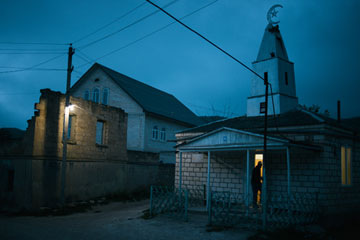
A man arrives at the village mosque in Utamysh.
(3 of 3)
What Tsarnaev Saw
Over the next two days, I hounded Gussein to track down some of the other guests at that cookout. He returned with odd news. All the guests he remembered had been arrested a week before in the town of Kizlyar, charged with resisting arrest and fighting with police. The event had been all over the news the week before. A wedding convoy of 20 cars had been stopped at a checkpoint for flying Islamic flags. The police deemed the insignia extremist, and when they ordered the wedding party to remove them, a brawl broke out. Gussein looked at my screenshots from the news footage of that incident and identified several of the men who had been with Tsarnaev on that beach.
One of them turned out to be Tsarnaev's distant cousin, Magomed Kartashov, the leader of a regional Islamist group called the Union of the Just. (The organization renounces the violent methods of the local militants, but shares their dream of establishing an Islamic caliphate under Shari'a.) The ride up to Kizlyar to find him took a few hours the next day. The cheapest way to get around Dagestan and the surrounding regions is on the marshrutka taxis, minivans that race from town to town along designated routes. You get used to them, but driving in Dagestan does present surprises. At one point we fell behind a military truck that the driver was unable to pass. Sitting in its bed was an enormous soldier who was resting the muzzle of his Kalashnikov on the back door — pointed directly at our windshield. So with the gestures of a man telling a slowpoke to get out of the fast lane, the driver tried to signal for the soldier to point his weapon somewhere else. His eyes smiled through the slits in his balaclava, and he shifted the barrel to the left.
The young men from that wedding party, mostly members of the Union of the Just, were the first people I'd met who were willing to talk about meeting Tsarnaev. He would have been hard to miss. As several people later told me, Tsarnaev had shown up at Friday prayers wearing a brown knee-length jubbah cloak like you might see in Morocco, but not in Dagestan, where men prefer T-shirts and track pants. He would slick his hair back with olive oil and pin it to his head with one of those plastic bands that David Beckham used to wear on the field. He would paint his eyes with the black eyeliner that men in the Persian Gulf sometimes wear. "He looked like an Arab," recalls Tagir Razakov, a young Salafi who knew Tsarnaev. "It's like he was trying to prove something." One afternoon Tsarnaev had almost gotten into a fistfight at the mosque when a young Salafi told him how ridiculous he looked.
On my second night in town, Rasim Ibadamov, a local Salafi from the Union of the Just, invited me to stay at his house, and he introduced me to his father as an American journalist. "American?" the father said before I'd even had a chance to sit down. "You know the guy who blew something up over there? He was here."
After his father went to bed, Ibadamov and I stayed up well past midnight discussing the Islamist desire for a society governed by Shari'a. It was not fanaticism or a medieval sense of justice that drove this mission. Most of the members of the Union of the Just had grown up in Soviet households with only the glancing presence of religion. But a few years ago, Ibadamov's computer store in Kizlyar had been run out of business by rent-seeking bureaucrats. Not long before that, his older brother had been killed in a fight with a local official's son, who went unpunished. "The laws of the state have ceased to function," he said. "So people naturally start to turn toward a higher law."
The next morning we went to the jailhouse to meet a few of the other men from the Union of the Just, who were due to be released after serving their time for the wedding incident. A handful of their friends were waiting on a dusty stoop. Some were well educated, even bookish, with an encyclopedic knowledge of Islamic doctrine that they liked to show off. Others were athletes, mechanics or former convicts with nicknames like Crowbar and Racket. (The nickname of Tsarnaev's cousin is tamer: the Intellectual.)
After about an hour of waiting, seven of their friends walked out of the jailhouse, and the group drove out to a house on the outskirts of Kizlyar to wash off the filth from their prison cells. They trimmed their beards and changed into clean clothes before laying down rugs and towels in the living room to pray. As they bowed toward Mecca and sat in meditation, led in prayer by a freestyle wrestler named Umar Umarov, I thought about the fact that Tsarnaev had spent weeks in their company last year. I could not fathom how his time with them could have inspired him to murder innocents on the other side of the world, supposedly in the name of Islam. America wants to know why Tamerlan Tsarnaev did what he did — but the answers won't be found in Dagestan alone.