

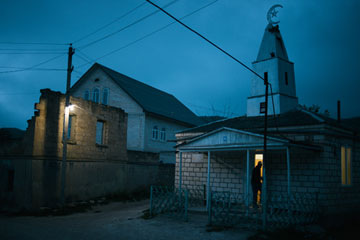
A man arrives at the village mosque in Utamysh.
(2 of 3)
Rules of the Mosque
On the advice of Temirchiev, I went the day after our meeting to check out one of the hot spots in Dagestan's civil war. These places are known as KTO zones, the Russian acronym for counterterrorism operation. Seemingly at random, the FSB draws these zones on the map of Dagestan, seals them off to isolate the real or phantom militants inside and imposes martial law there until they are killed or captured. Under Russian law, the constitutional rights of anyone inside these zones are suspended for the duration of the KTO regime, which can last a few days or a few years. There is usually at least one under way on any given day in Dagestan, and the bloodiest one at the time was in Gimry, up in the mountains.
The drive to Gimry goes up through jagged cliffs, which proved too steep for my driver's old Lada. Less than half the way up the mountain, he burned out the clutch, and we had to roll and push the car backward a few kilometers toward a service station. (This happened to coincide with the only rainfall during my 17 days in Dagestan.) It was only then that I noticed the camouflaged dugouts carved into the sides of the mountains, where Russian snipers perch to watch the road. Apart from the military checkpoints dotting every highway, these trenches are the only places in Dagestan you are sure to see a bona fide Russian Slav, blue eyes showing through the holes in their balaclavas.
By this point the conditions of the trip were becoming challenging. My backpack held enough clean clothes for only four days — which had passed — and the hot water had been out in the entire city of Makhachkala since my arrival. At first people said it would be back on in a few days, then two weeks. Nobody seemed to care. My plan was to hang around for another few days until Friday, when the imam on Kotrova Street was due to give his weekly sermon.
I had never been inside a mosque before, and had never been close to one associated with Salafism, the brand of ultraconservative Islam that has been spreading throughout the Muslim world. That first time on Kotrova Street was initially unsettling. The tone was set by the alms boxes labeled: FOR THE CHILDREN OF SHAHIDS — a term for someone killed in battle that is often applied to suicide bombers. As the worshippers gathered, I mimicked them washing their hands and feet and tried to look inconspicuous. My aim was to hear the sermon from up close, but my only thought was how not to get outed as an interloper and expelled, possibly lynched. Even before the service began, I was sweating. My nerves must have given me away, but instead of booting me out, the men around me explained in whispers how to pray and why each gesture was significant. By the end we were laughing, and one recommended the name Suleiman — the great 16th century Sultan of the Ottoman Empire — in the event of my formal conversion. "But first you'd have to do the snip-snip," he said, pointing at my crotch and smiling.
The imam, Khasan-Khadji Gasanaliev, agreed to an interview a few hours after the service and invited me up to his office on the third floor, just beneath the emerald-colored dome. We had been talking amicably for about 20 minutes when one of the imam's assistants, who had the tough look of a special-forces alumnus, entered the office and sat down. For a few minutes he eyed me with a smirk, and broke in only when I turned the conversation back to Tsarnaev's time in the region. "And what is your ethnicity?" the man interrupted.
Pride or stupidity — maybe both — did not let me lie. "My mother is Russian," I said. "My father is Jewish." He was already aware that I wrote for a U.S.-based publication, and the rant that followed killed any chance of continuing the interview. The imam sighed, got up and began preparing for the next call to prayer, washing his hands and feet in a sink in the corner of the room while his assistant stood up and continued yelling: "Americans are bombing the Muslim world for how many years? And you help them do it! Don't lie to me! You are carrying these mortal sins!"
Still, the visit was worth it — one of the friends I made on Kotrova Street, a taxi driver named Magomedgadzhi, gave me a tip about Tsarnaev. Magomedgadzhi had agreed to show me the house of a suspected terrorist who had been blown to bits by the special services, and he mentioned in passing as we were driving there that his cousin had seen Tsarnaev in the flesh. (This is what we call in the news business "burying the lede.") The cousin turned out to be a 36-year-old construction worker named Gussein, a lapsed Salafi who had been invited early last summer to a cookout on the beach attended by a brash young American boxer named Tamerlan. "He said none of those black fighters in America ever hit him in the head, that's how good he was," Gussein told me.