

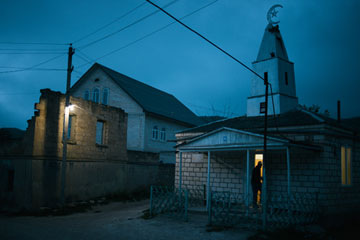
A man arrives at the village mosque in Utamysh.
In the mind of the average Russian, the impoverished Muslim region of Dagestan evokes any number of stereotypes: meek women in headscarves, leathery highlanders with tall sheepskin hats, Islamist fanatics with long beards and ceremonial daggers, streets patrolled by military vehicles, masked troops with assault rifles, and random, indiscriminate explosions. Those last three images also applied to Boston during the manhunt for the alleged marathon bombers, the Tsarnaev brothers, the older of whom — Tamerlan Tsarnaev — spent six months in Dagestan last year. I traveled from Moscow to Dagestan on April 20, the day after news broke of the Boston connection, in search of clues to Tsarnaev's motives in the attack that killed three, wounded hundreds and brought terrorism back to America's front pages. I found people who'd met him and the mosque where he prayed. I also found that the region in southern Russia is a lot more complicated than cosmopolitan Muscovites imagine, and in its own way, a lot more charming. Just make sure you pack enough clean clothes.
On my first night in the capital, Makhachkala, a few local journalists and academics — the self-described dregs of the intelligentsia — invited me to a basement café in the center of the city to share a discreet bottle of brandy and talk about their republic. Dagestan is a rough place in a rougher neighborhood. To the west lies Chechnya, whose two separatist wars against Russia in the 1990s spilled over into Dagestan in waves of refugees, Russian troops and Islamic extremists. The influence of radicals who trickled in from around the Arab world made a tinderbox out of Russia's southern flank, turning a series of post-Soviet struggles for independence into an ongoing holy war to evict the Russian heathens from Muslim lands.
The toastmaster that night was Sabir Geybatov, an artist and philosophy professor with a mangy goatee. He dropped the names of 19th century German thinkers into our discussion of contemporary Dagestan, but his view on the problem of Islamic radicalism was more straightforward. "How can you fight an idea?" he asked. "You can hope to change it through dialogue. But you cannot kill it" — though people have tried for centuries. Dagestan is on "the front line in the war of civilizations," said Geybatov. It is the point where Persians and Turks from the south have tended to meet the Christian crusaders from the north, a place where holy war is not an abstract concept. It has at some point taken lives from nearly every family in this region of some 3 million people.
At present this war has two opposing fortresses in Makhachkala. On Dakhadaev Street stands the hulking base of the FSB secret police, which maintain Moscow's fragile hold over this region as they always have — by brute force. A far less imposing bastion stands a short walk away on Kotrova Street — a green-domed mosque where the local Islamists congregate. That is where Tsarnaev spent a lot of his time last year, during his pilgrimage to his homeland.
The history of the Kotrova Street mosque deserves its own biopic. Its founder, Nadyr Khachilaev, is a Dagestani hero. In 1998, two years before he built the mosque, Khachilaev was serving as a member of the Russian parliament when a mob of his supporters, on his instructions, armed themselves with rifles and stormed the headquarters of the corrupt local government, briefly taking it over. The year before, Ayman al-Zawahiri, the current leader of al-Qaeda, had visited Dagestan, and Khachilaev was his host. Among the Islamists on Kotrova Street, he has been seen as a martyr since he was shot dead near his home in Makhachkala in 2003. In his honor, the mosque was named An-Nadyriya (Arabic for "belonging to Nadyr").
I found most of this out from one of the men who helped build the mosque, Magomedtagir Temirchiev. Stooped and weathered from the six years he spent in prison on charges of abetting terrorism, Temirchiev agreed to meet me on the terrace of a café around the corner from the mosque. As we spoke, he seemed to be almost proud of being a prime suspect in Russia's war on terrorism. "Every time something blows up, they drag me in for questioning. They want to hear my alibi," he said, laughing. "Something blows up in America, in Boston, they come to the mosque on Kotrova Street." After a pause, he added, "I guess I can't blame them."