

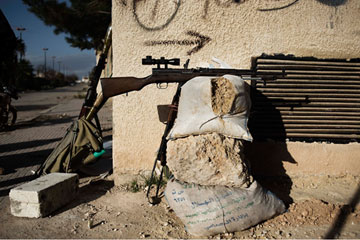
Free Syrian Army's sniper position, in Al Qsair, on February 9, 2012.
(4 of 4)
"He's gone anyway. What good is thinking about it? I did--for a long time afterward. I thought, 'Why? He was my friend. Why did I shoot at him? I shouldn't have.' But I have left those thoughts behind me. I have to move forward."
Like many men on the front line, the Sniper has found solace in religion. But his is a politicized form of Islam. He speaks admiringly of the extremist group Jabhat al-Nusra, which has been responsible for some of the most spectacular suicide bombings against regime targets. "They are clean and doing good work," he says. He wants to join them if he can "cleanse" his body and mind, he says, pointing to a red pack of Gauloises cigarettes. A day later, he quits smoking.
He was not always like this. An avid boxer before he was the Sniper, the young man lived in Hamburg for five years, returning to his homeland in 2010. He attended the Goethe-Institut in Damascus and says his Arabic was so poor, he could barely read. It has since improved to the degree that he now reads the Koran aloud to his fellow rebels. He has long since shelved his dream of returning to Germany and training as a boxer. In fact, he doesn't want to survive the Syrian uprising and is seeking "martyrdom." "I'm only comfortable on the front line," he says. "My rifle has become not just like a part of my body. It is my life, my destiny." He remembers his religious awakening, during the first assault he participated in. It was a hit on a checkpoint on the road to the town of al-Bab on Aleppo's outskirts. "We ambushed them. There was an Islamist with me. My heart was filled with faith. He told me the only thing between me and paradise was this road, was dying on this road. I was sorry that I lived."
A few days later, we return to the issue of victims, of whether or not they were all shabiha, and his friend Mohammad. At the end of the day, I tell him, he is a Syrian killing other Syrians. "I used to think about the people I'd killed. I'd think about their parents," he says. "Yes, we are all Syrian, but we didn't create these differences, they did. It is because I am Syrian, because these people, these civilians who are dying are Syrian, that I am doing this, that I am standing with and for my people. Those who are not standing with their people are not Syrian, they are traitors, and traitors must die."
And Mohammad? Was he a traitor? No, he says, he wasn't, but "I've accepted it now, and nothing matters to me anymore."
"Whoever is going to be in my sights will die. That's it," the Sniper says. "My heart has hardened. I returned to religion, but after I killed, my heart hardened. A sniper sees who he kills," he says, pausing. "It's hard. A sniper sees his victim."