

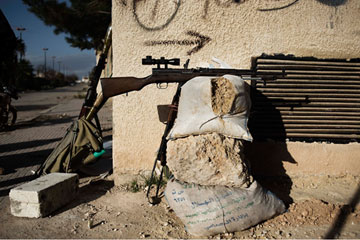
Free Syrian Army's sniper position, in Al Qsair, on February 9, 2012.
(3 of 4)
He is always on the lookout for new sniper positions. "Are you ready?" he asks before running alongside me as we dash past regime snipers to minimize my chances of being hit. We walked through the deserted neighborhood, up darkened stairwells and through a maze of holes punched through apartment walls to avoid exposure on the streets. The Sniper kicked in locked apartment doors, moving through family rooms and kitchens with rotting vegetables as he searched for higher, better ground. He paused in one living room to feed fish in a tank. A few days later, he replaced the damaged locks of the apartments he had entered. In one apartment, on the fifth floor, a blackened male corpse lay in a bedroom. The rubble strewn around the room from the gaping hole in the ceiling made it clear what had killed the man. The stench was tear-inducing. Fat maggots crawled on the bloated corpse. Several rebels removed the body, wrapping it in a blue blanket. The next day, the small group, along with the Sniper, returned, methodically removed the china from a dining-room cabinet and placed it in a dusty lounge area before punching a small hole through the dining-room wall. The room looked out onto a government position in the shrubbery below and would serve as a new rebel outpost.
Still, on some days, the Sniper says, he doesn't even fire a shot. He just watches and waits in nearly dark apartments with no power, alone with his thoughts. His victims, when he speaks of them, were all shabiha, progovernment paramilitary thugs--an easy term to wield when he wants to dehumanize his enemies. But he knows it's not quite accurate. He knows his childhood friend Mohammad was not a shabih. He says he doesn't know if his bullet--or one of his colleagues'--killed him.
"We were in school together. We grew up together. His mother was like my mother, that's how close we were," he says. The Sniper is pensive, takes several deep breaths and fidgets with his 10-mm handgun as he speaks of his friend, repeatedly flicking off the gun's safety. The young men joined the army together and stayed in contact even after the Sniper defected. He was the only person outside of the Sniper's immediate family who knew that he was still alive. "I would tell him to defect. He'd say, 'Not yet, it's still early.' I'd say defect. I told him I'd come and get him, that I would go anywhere to see him, to help him defect, even to the gates of his brigade. Whatever he wanted, wherever he was, I would get him. He kept saying, 'It's still early, it's early.' He was scared that his family would go through the same thing my family went through." The Sniper says his family members were interrogated, harassed, ostracized in their community. The only thing that saved them from greater harm, he suspects, was the clout of the loyalist military men in his family and the fact that they thought he was dead, not a defector.
Mohammad was eventually sent to Azaz, stationed at what was called the Shatt Checkpoint. Both the Sniper and his commander repeatedly urged Mohammad to defect, warning him that they planned to attack the checkpoint. He didn't listen. "We were three snipers. We killed a colonel, a soldier and my friend. I don't know which one I killed. I didn't see their faces. They were soldiers in front of us, and we were ordered to kill them." That was three months ago.