

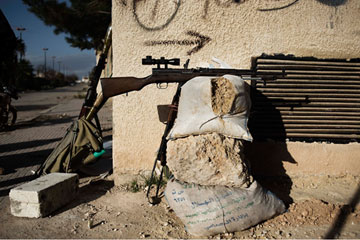
Free Syrian Army's sniper position, in Al Qsair, on February 9, 2012.
(2 of 4)
The Syrian revolution is also unrecognizable from 20 months ago, when Syrians first took to the streets in peaceful protests demanding freedom and dignity from a totalitarian leader who allowed little of either. The uprising soon morphed into an armed revolt as soldiers defected and men took up arms against the loyalist troops who were shooting into the crowds and going house to house looking for dissenters. As the conflict became deeper and bloodier, and the international community looked on impotently, armed rebels scrounging for help were increasingly compelled to compete for resources. Various backers--Syrian and foreign, private and state-sponsored--entered the fray, picking their men on the ground and funneling weapons and money to them. The help wasn't always free; it often required pledges of allegiance, which many rebels have said they made with little intention of keeping. The money and weapons haven't really bought the rebels' love or obedience, just their temporary gratitude.
Over the past few weeks, the rebels have made sizable inroads in many parts of the country, but in Aleppo, Syria's largest city and its once pulsating commercial hub, the intense firefights and dramatic capture of neighborhoods that marked their initial frenetic push into the city have largely stalled. Although the government's warplanes and heavy weapons continue to pummel various neighborhoods, and the rebels continue to try to pound their way forward, the fight has ground to a stalemate in many areas that fell out of government control early on. In these districts, territory gained is measured in street corners and meters rather than neighborhoods. And the snipers reign. A few good sharpshooters can effectively freeze a front line by making any movement by their rivals too costly.
So rebel snipers, especially professionally trained ones, are in great demand. The Sniper says he has "been offered so much money, it is as if I am working for the mafia."
"Some [rebel commanders] offered me money. Others would say, 'Just tell me what you want.' One told me, 'I'll bring your parents, take them to safety. Just come and work with me,'" he says. "It does not honor me to work with people like this who think they can buy and sell me."
Instead he has found a home with Liwa Suqoor al-Sha'aba, an Islamist unit of the Free Syrian Army headquartered in Azaz, a town north of Aleppo in the vast band of countryside in rebel hands around the city. For the past few months, he has been stationed in the northeastern neighborhood of Bustan al-Basha, a devastated wasteland emptied of all but three of its thousands of residents. "We cannot charge on [government] positions--if we do, they will eliminate us--nor can they advance on us," he says. "It's not that I'm tired, but I want something new. New territory. I'm sick of it here. I'm disgusted by it." But he respects his adversaries, who he says have pinned the rebels down for months.