

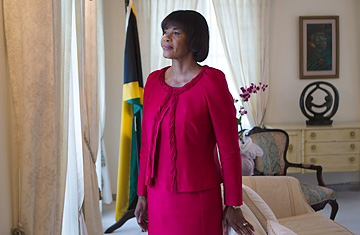
Jamaica's head of government, Prime Minister, Portia Simpson Miller. Portia Simpson Miller, is the leader of the governing People's National Party (PNP)
(3 of 3)
Bunting is targeting a homicide rate of 12 per 100,000 by 2017, when Simpson Miller is required to call new elections. That's prodding islands like Trinidad, whose murder rate is 27 per 100,000, to follow suit. Still, while U.S.-aided interdiction over the past decade has reduced drug trafficking throughout the Caribbean islands — though the bad news is that it has simply moved west to Central America — Caribbean security chiefs like Bunting say they're already seeing a new uptick in the narcotrade. And it could worsen this decade if the region can't generate more economic opportunity in places like Jamaica, where nearly half the population is poor.
Hence the Caribbean conundrum: "Violence in the region imposes constraints on economic growth, which in turn further fuels crime and violence," says Mark Feierstein, Latin America and Caribbean assistant administrator for USAID, the U.S. State Department's development agency. "It's a vicious cycle." Caricom itself estimates that gang-related crime costs the region as much as 4% of its GDP, including lost tourism and foreign investment. Jamaica, whose unemployment rate is 14%, may be losing $520 million a year.
Island of the Future
Debt service is an added drag. Simpson Miller is trying to balance the fiscal prudence the International Monetary Fund wants with an $80 million infrastructure-improvement program that aims to create 40,000 jobs. On the streets, the government's Peace Management Initiative (PMI) tries to defuse turf disputes and steer Jamaicans from gangs with names like Rat Bat into legitimate work. With PMI help, Odain Tennant, 24, now a community activist, runs a small but thriving urban pig farm in St. Andrew South West, Simpson Miller's parliamentary constituency. "You get my drift, mon," says Tennant. "More income for youth here mean less ghetto conflict." Notes PMI Programs Manager Damian Hutchinson: "Portia's challenge is to use her credibility on these streets to fill the void left behind by dons like Dudus."
But Jamaica and the Caribbean have to evolve beyond a dependence on low-wage tourism, especially self-contained, all-inclusive resorts that generate scant commerce for local businesses. Simpson Miller thinks value-added investment in indigenous products like Jamaica's distinctive chocolate is one solution. Either way, regional Caribbean growth, despite Trinidad's prodigious oil and natural gas exports, was just half the 4.2% expansion Latin America as a whole had in 2011. "The debt crisis marks a turning point," says Jamaican social-science researcher Horace Levy of the UWI, author of The African-Caribbean Worldview and the Making of Caribbean Society. "Our inequality has to be dealt with — and we must become more entrepreneurial and produce things."
Levy hopes Simpson Miller will challenge Jamaica in that regard, just as she's urged the country — 90% of whose population is black — to become a republic. "The Queen is a wonderful person," Simpson Miller says. "But independence for us is a long journey, from slavery and then from colonialism, and it is now time for us to have our own form of government." She has also called on Jamaica's Parliament to reconsider an archaic law, which other Caribbean countries like Barbados have on their books, that criminalizes homosexuality. "I'm a Christian woman, but I believe in human rights," Simpson Miller tells me. "I do not go into people's bedrooms."
Dionne Jackson Miller, host of the Jamaican television news talk show All Angles, says Sister P could push the island "to punch above its weight, just like our Olympic sprinters are doing." If Jamaica in the next 50 years can channel that lightning into its politics and economy, then it don't 'fraid a no man, no gyal, nowhere.