

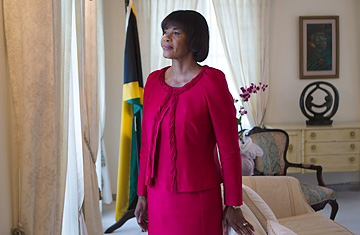
Jamaica's head of government, Prime Minister, Portia Simpson Miller. Portia Simpson Miller, is the leader of the governing People's National Party (PNP)
At the height of his criminal reign, Christopher "Dudus" Coke was more than a violent drug lord whose powerful street gang helped turn Jamaica into a murder capital. The President, as Coke was called, was the political don and de facto ruler of a chunk of inner-city Kingston, Jamaica's capital. When the government finally moved to arrest him and extradite him to the U.S. in 2010 on drug-trafficking charges, 76 people died in clashes between security forces and his army of supporters.
Coke was sentenced in June to 23 years in a U.S. federal prison — and most Jamaicans are hailing his downfall as their Caribbean island nation celebrates the 50th anniversary of its independence on Aug. 6. But they're also hoping new Prime Minister Portia Simpson Miller — Jamaica's first female leader and the first to hail from the kind of gritty Kingston enclave that Coke once dominated — can help make the next half-century even better by reducing violent crime and the poverty that spawns it.
Simpson Miller, 66, is aware of the epochal expectations created by her landslide election at the end of 2011. In an interview with me in her office at Jamaica House in Kingston's historic Uptown district, the only time she dropped her calm, maternal demeanor was when I mentioned Coke. "I've spent my political life fighting all those who bill themselves as 'dons,'" she said in a stern tone. "If we empower people in their communities and get them jobs, no one like Dudus Coke can capture their hearts and minds and hold them hostage."
Jamaica, if not the rest of the troubled Caribbean basin that includes Central America and the South American coast, is juggling jubilation and angst this summer. The first and largest of 10 Caribbean islands to win independence from Britain, Jamaica (pop. 3 million) has a lot to celebrate besides its beaches. It's kept up a working democracy — no mean feat for any former colony. "We've proven a strong, determined people in our first 50 years," says Simpson Miller. Institutions like the University of the West Indies (UWI) have earned international respect. And from reggae music to Rastafarian chic, few small developing nations have ever branded themselves as well as Jamaica has — a point likely to be driven home at the London Olympics, where a juggernaut of Jamaican runners led by world-record holder Usain "Lightning" Bolt and Yohan "the Beast" Blake may sweep the sprints in the same week exuberant Jamaican street festivals mark the nation's break from British rule.
But gold medals can't hide the crises Jamaica and the Caribbean face. Murder is down in Jamaica since Coke's arrest, but the U.N. warns that the Caribbean basin as a whole — especially Central American nations like Honduras, which has the world's highest murder rate at 86 killings per 100,000 people — still accounts for an inordinate share of global homicide and large-scale drug trafficking. Foreign debt is another albatross. Five of the world's 13 most indebted nations, as a share of gross domestic product, are Caribbean islands — including Jamaica, whose debt is 129% of its $15 billion GDP, and St. Kitts and Nevis, whose crushing 180% debt-to-GDP ratio is even higher than Greece's 165%.
The threat of a euro collapse has the world focused on Greece. But for five centuries, everyone from English pirates (as evidenced by all the Spanish galleons lying on the bottom of the Caribbean Sea) to Soviet Premiers (think Cuban missile crisis) to international drug lords (impoverished islands like Haiti are among their favorite cocaine transit sites) have demonstrated that the Caribbean, the Western Hemisphere's nexus region, is vulnerable — and that it matters. "The powerful countries should pay more attention to the Caribbean if only because of our strategic location," Simpson Miller argues. "If we don't have the ability to deal with our problems, it can prove a problem for them."