

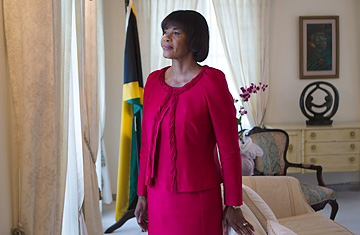
Jamaica's head of government, Prime Minister, Portia Simpson Miller. Portia Simpson Miller, is the leader of the governing People's National Party (PNP)
(2 of 3)
The Fearless Sister P
That's why Simpson Miller — who at her January inauguration called for a referendum on ditching the British monarch as Jamaica's head of state (the Prime Minister is head of government) and making the Commonwealth nation a republic — is pushing a resurgence of the Caribbean Community (Caricom), the seldom-used 39-year-old regional-integration organization. "By ourselves I don't think [Caribbean countries] can achieve as much, like debt renegotiation with multilaterals, as we can if we speak with one, more powerful voice," she said. She also wants Jamaica to set a regional example for reform, from anti-organized-crime task forces that go after the finances of mafiosi like Coke, to improved civil rights for homosexuals, which many consider a particularly courageous stance amid the severe homophobia that exists in Jamaica and the Caribbean — a product of the region's conservative Christianity and the strict heterosexual morality of Jamaica's syncretic Rastafarian sect.
Simpson Miller is still proving herself as a Prime Minister. She first occupied Jamaica House after longtime PM P.J. Patterson resigned in 2006. But after 15 years of rule by her liberal People's National Party (PNP), voters wanted change, and the PNP lost the 2007 elections to the center-right Jamaica Labour Party (JLP). Still, she opened doors for other women in the Caribbean. Trinidad and Tobago, the basin's second most populous former British colony, which also marks 50 years of independence this year, elected Kamla Persad-Bissessar its first female PM in 2010. "More women in leadership is pushing governments forward around the world," says Simpson Miller, a tall, striking woman known for her bobbed hair and the nickname Sister P, who can be as fierce on the stump — "I don't 'fraid a no man, no gyal, nowhere!" she has roared in Jamaican patois — as she is amiable in conversation.
Sister P came of age politically during the 1970s, when violent cold-war disputes between PNP and JLP backers led to links between criminal dons and the two parties. That brand of dirty, so-called garrison politics has plagued Jamaica ever since. Former PM Bruce Golding resigned in 2011 under criticism of his JLP's alleged financial ties to and protection of Coke, which the party denies. A major reason for Simpson Miller's landslide election victory last December, say supporters, is her distaste for gang-party bonds. "She's a woman capable of taking Jamaican politics by the scruff of the neck and moving it in a new direction," says Jamaican-American attorney David Rowe, an adjunct law professor at the University of Miami.
Cutting the Killings
Reform of the police and judiciary is urgently needed across Latin America and the Caribbean, but especially so in Jamaica. Simpson Miller has instituted a Major Organized Crime and Anti-Corruption Task Force and introduced legislation to make prosecutors and judges more responsive. (Given a murder rate that reached 60 per 100,000 residents in 2010 before easing to 41 per 100,000 last year, Jamaica's minuscule 5% murder conviction rate is embarrassing.) The new laws would also let authorities seize money-laundering assets from alleged criminals. "When you look at resource-strapped countries like ours, where investigators have heavy caseloads, the best way to bring down the kingpins is to get at their money," says National Security Minister Peter Bunting.