

(3 of 3)
Leung says he will release more land for private development and build more and better public housing for the underprivileged by drawing on Hong Kong's $85 billion of fiscal reserves. Unsurprisingly, the Real Estate Developers Association is lobbying Leung not to "flood" the market and weaken prices. But with public opinion on Leung's side, legislators are unlikely to block his proposals (even if they stall him in other areas), while Chinese officials will quietly welcome any measures that pre-empt social unrest.
If anyone is distressed about Leung's plan to throw money at Hong Kong's problems, it's the city's old guard. "I hope Hong Kong does not go down that slippery slope toward large government, persistent budget deficits, heavy public debt, financial meltdown and monetary crisis," warned Joseph Yam, a former head of the Hong Kong Monetary Authority and an open backer of Leung's rival Tang, in a recent academic paper. Should the world be worried that Hong Kong is abandoning market forces? Leung's supporters say he wants to tinker with, not transform, Hong Kong. "I don't see him like Hollande in France or even Obama — these people are far more radical," says former Solicitor General Daniel Fung. "[But] because he doesn't espouse Hong Kong's usual freewheeling capitalism, the Establishment thinks this guy's seriously wacko."
Mr. Controversial
Over everything looms the shadow of China. During a TV debate between Leung and Tang before the CE vote, Tang said that in Executive Council meetings Leung had suggested using tear gas against demonstrators protesting the introduction of an antisubversion law and had recommended placing restrictions on an independent-minded private broadcaster. Leung denied this, and because council meetings are confidential, none of its other members would publicly verify either man's assertions. But Tang's claims reinforced what Leung's critics believe: that he possesses a hard-line streak and is Beijing's agent. Says legislator and democracy activist Leung Kwok-hung (no relation): "He is a ruthless guy whose agenda is to serve China's communists."
In a way, Hong Kong is projecting onto Leung its attitude toward China, which, even after 15 years as a part of the People's Republic, is ambivalent at best. Hong Kong people take pride in China's global might and readily accept the economic goodies, like trade privileges, the mainland tosses their way. But, accustomed to a free and Western-style society, they also fear Beijing gradually imposing authoritarian controls on their home.
That fear expresses itself in ways big and small. Hong Kong is the only place in China to commemorate the 1989 Tiananmen crackdown every June 4. This year, at least 100,000 men, women and children, including many mainlanders in Hong Kong, held a candlelight vigil in one of the city's major parks. A week later, about 25,000 marched to the Chinese liaison office in Hong Kong to protest the suspicious hospital death of long-jailed Tiananmen activist Li Wangyang, who mainland authorities claim committed suicide. It's not just human rights. Hong Kong citizens deeply resent, for example, mainland mothers using the city's medical services to give birth. Some months ago, a cell-phone video of a Hong Kong man berating a Chinese woman for letting her child eat on the subway went viral as an illustration of how mainlanders don't respect Hong Kong's rules.
Given such a climate, Leung's closeness to China can be a liability — yet also an asset. Even before taking office, he announced that effective Jan. 1, 2013, mainland mothers whose husbands are not Hong Kong residents would be barred from using the city's private hospitals to give birth. Beijing officials raised no objection to the ruling, probably because they wanted to shore up Leung's position in Hong Kong. "I have credibility with the Chinese leadership," he says.
The biggest test of his relationship with Beijing will be whether Leung delivers on China's promise to allow Hong Kong to directly elect its Chief Executive in 2017. Despite populist overtures in other areas, Leung doesn't seem totally committed to full democracy. He notes that the Basic Law requires a nomination mechanism for candidates — which sounds like a less-than-open process. "If you look at [Leung's manifesto]," says James Tien, a property and garment magnate, "it touches very little on human rights and democracy."
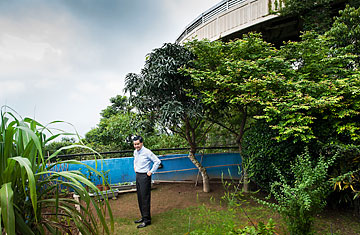
Leung's personal credibility too is a major political challenge for him. Just days before his swearing-in, he was embroiled in another controversy when the press exposed unauthorized modifications to his Peak home. While Leung acknowledged he was "seriously negligent," he denied knowing the structures were illegal when he bought the property. Still, a symbol of his realization of the Hong Kong dream was now a reflection of the same sin that helped bring down his rival Tang. Suddenly, the outsider seemed little different from an Establishment insider.
Win the trust of Hong Kong's citizens. Ease social inequality without alienating Big Business. Foster democracy without unsettling Beijing. By any benchmark, Leung has a huge task ahead of him. But he might have karma on his side, perhaps even destiny. Government House is the white colonial mansion set in 2.5 hectares of gardens where almost all of Hong Kong's past leaders have lived. Leung's father used to stand guard at Government House. Now the son will rule from it. If Leung stands for anything, it's the notion that anything is achievable. That, above all, is the spirit of Hong Kong.
—with reporting by Joe Jackson And Vanessa Ko / Hong Kong