

(2 of 3)
Despite being written off even before nominations closed in late February, Leung kept hammering away, not just wooing the Election Committee but also frequently going straight to the people, even though they couldn't directly vote for the CE — making speeches, pressing the flesh, in the hope that his higher public ratings would sway committee members. "I bring with me a stool, a notepad and a pen," he would say on neighborhood visits, especially to marginalized areas. "If you are willing to speak, I am ready to listen." Most in the Election Committee, particularly the moguls, stuck to Tang. Only in the last few weeks of campaigning did Leung gain traction when Tang self-destructed in part from a couple of personal scandals — admitting adultery and the fact that he had an illegally built, luxuriously fitted basement under one of his properties.
With Tang sliding in public surveys, Beijing put its weight behind Leung and, local media reported, influenced delegates to toe the new line. That string pulling may have helped Leung win by a narrow majority, but it also sparked alarm. Longtime accusations that he is a covert member of the Chinese Communist Party re-emerged (he has repeatedly denied this), and many concluded that he must have struck a sinister Faustian bargain with China's leaders in return for their backing. Leung says otherwise: "If [Beijing] helped, I don't know how, because up to 11 p.m. the night before [the vote], I was ringing for the nth time the election members. I worked my tail off winning their votes."
As Leung tells it, his work ethic was drilled into him by his policeman father and his mother, an illiterate villager, both from China's northeastern Shandong province, who made their way to Hong Kong, where Leung was born. When a child, he helped his parents sell plastic knickknacks after his father retired from the force. The family earned enough to buy a 42-sq-m apartment in a low-income neighborhood. Leung's elementary-school grades got him into a good public high school. He obtained a local diploma in land surveying, then went to Britain, laboring in Chinese restaurants to help pay his way through college and another diploma, in land valuation and management.
None of that was uncommon for a motivated, diligent Hong Kong youth, even one from a disadvantaged background. Still, by just 28, Leung had become the youngest partner in the Hong Kong office of British real estate consultancy Jones Lang Wootton and, soon after, its chairman, before eventually launching his own firm. (Locals called him "emperor among workers.") Leung realized early on that China was the place to be and, starting in the 1980s, ventured often across the border to drum up business and give seminars on land and housing reform — even, he says, to Communist Party cadres. And he did so with polish: most Hong Kong Chinese are Cantonese and speak notoriously spotty and accented Mandarin, but Leung's is impeccable.
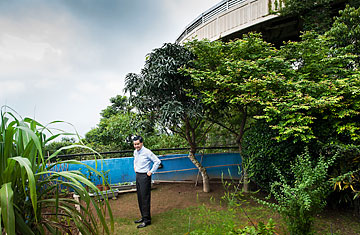
Today, Leung straddles both high and low worlds. He occupies a town house on Victoria Peak, Hong Kong's toniest neighborhood. Yet he enjoys street food and will readily order $4 meal boxes — the kind consumed by construction laborers — when working through lunch. His briefcase is the same worn black one he used in college, and he has been known to take the subway to beat the traffic. These may seem small things but, in status-conscious Hong Kong, practically no one with wealth or power would be caught slumming it.
Change Agent
The territory has a reputation worldwide for being extraordinarily rich, and for good reason. It has more billionaires per capita than any country. Flashy skyscrapers stud the landscape, and Mercs and Beemers clog the streets. But Hong Kong is also "cagemen" living in wire-mesh bed spaces, hunched elderly folk collecting trash at dawn and the highest Gini coefficient — a measurement of income inequality — among developed societies. On June 18 the government released figures that showed the wealth gap at its worst in 30 years. About 20% of the 7 million population — more than a million people — live below the poverty line, which in Hong Kong is $40 a day per household.
Because he was once poor himself, Leung gets it about being hard up. "Many people in the elite group do not believe we have abject poverty," he says, scathingly referring to the Establishment's "Central District values" — its metropolitan insularity. Hong Kong, he says, "would do a lot better if everyone could just travel out a bit and see how not just the other half but probably the other 75% live."
Suen Mo is one of those 75%. A construction worker handicapped by back injuries, Suen, 39, rents a 6-sq-m room on the seventh floor of a walk-up on the edge of Sham Shui Po, one of Hong Kong's most depressed districts. Suen's monthly rent is $210, which he manages to pay with the help of a government allowance. The bare-walled room can hardly fit his belongings: a small mattress, a TV, a few hanging clothes and some boxes. Suen, a residents' representative at two community meetings with Leung, is confident the new CE will give underprivileged citizens like him a better life. "He will not only say something but do something."
That means tackling housing, Hong Kong's singular hot-button issue. Despite the city's international image as a center of finance and trade, it's property that drives the local economy — averaging a fifth of annual government revenue through land sales and almost a third of GDP. Most of Hong Kong's big local companies have real estate as their core business, generating billions in cash flow that they plow into other sectors. For individuals, owning and trading property is the key to upward social mobility. About half the population live in their own homes. But that is increasingly beyond many citizens, who accuse developers and officials of colluding to keep supply tight, and thus prices high, and blame wealthier mainland Chinese buyers for elbowing them out of the market. Because the high cost of real estate has a ripple effect throughout the economy, the middle class is squeezed ever more tightly while the poor get poorer.