

For as long as anyone can remember, the business of Hong Kong has been business. The most succinct reflection of that is the postcolonial title of the territory's head of government. It's not mayor or minister, but Chief Executive. The job description effectively matches the title: maintain a positive balance sheet (deep fiscal reserves), satisfy your major shareholders (domestic and foreign conglomerates and banks), execute top-down management (the Establishment knows best). The formula proved wildly successful for the colonial British, who coupled their administrative skills with the enterprise of the local Chinese to transform a clutch of villages into the most intensely commercial aggregation of humanity on the planet. In 1997, when the British returned Hong Kong to China, Beijing followed the template. After all, if it ain't broke, don't fix it.
Hong Kong ain't exactly broke. It's a financial powerhouse and a gateway to and for China — nearly half of foreign direct investment in China has originated from or gone through Hong Kong, as well as about 15% of the mainland's total trade last year. It's also a unique experiment in sovereignty: an open, international enclave prevailing within an authoritarian state.
But in recent years, Hong Kong has been in flux. This freewheeling society has also become a fragmented, discordant one, unsure of itself and its place in China. The economy lacks direction, while the city's glittering wealth masks a widening income gap with intimations of class warfare. Ordinary people are increasingly agitated over everything from the ever rising cost of living to the cozy ties between government and Big Business to what is widely perceived as Beijing's growing influence. Hardly a week goes by without some street march over some cause or grievance. Many citizens think Hong Kong needs fixing.
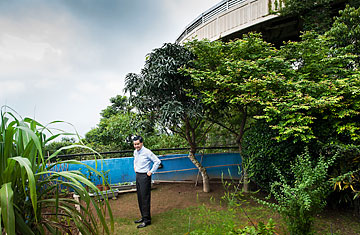
Leung Chun-ying believes he's the one to fix Hong Kong — a different leader for a different era. On July 1, the 15th anniversary of reunification, China's President Hu Jintao is expected to swear Leung in as Hong Kong's third Chief Executive (CE). He is unlike any helmsman the territory has had. The British governors were mostly Foreign Office mandarins (plus one politician, Chris Patten, the last of the line). The first two CEs were a grandfatherly shipping tycoon, Tung Chee-hwa, who was a transition figure, and a career civil servant, Donald Tsang, who lacked gumption. Their experience of life was in bubbles — the family firm for one, the bureaucracy for the other. By contrast, Leung, 57, is a self-made man from the real world: a beat policeman's son who worked his way through college, became a land surveyor, prospered in the tough China market, entered public service and never forgot his past — a past that shapes his vision of Hong Kong's future. The territory, Leung told TIME in a recent interview, requires a reset: "A slightly more proactive role of government in economic development. A fairer sharing of the pie. And putting behind us, for good, the short-termism that has plagued Hong Kong."
Many governments adopt such strategies. But by signaling greater intervention, Leung is departing from Hong Kong's sacrosanct laissez-faire policy. While lower-income residents desiring a new deal back Leung, tycoons brand him a socialist bent on eroding the territory's fiercely capitalist ethos. Many liberals distrust Leung too. Depending on who's talking, he is smart, caring and resourceful — or a cunning, bloodless stooge for Beijing who will curb Hong Kong's freedoms. His critics call him "the wolf" and distribute posters of him in a Mao suit. To this divisive figure falls the task of healing the divisions in one of the world's most iconic cities.
A Man Apart
I first met Leung two decades ago for a story on Hong Kong's future in the run-up to the 1997 transfer of sovereignty and beyond. Those were jittery years. China promised Hong Kong that it could mostly run itself and retain its two most important features: rule of law and freedom of expression. Deng Xiaoping called it "one country, two systems." Many in Hong Kong didn't think Beijing would keep its pledge — from 1984 to '97, about 800,000 residents emigrated. Leung's assessment mattered because, though then only in his 30s, he regularly met mainland officials in his capacity as secretary general of the Basic Law Consultative Committee, which oversaw the drafting of Hong Kong's post-'97 miniconstitution. Speaking in the British-accented English acquired during his studies at Bristol Polytechnic, he impressed me with his grasp of both the details and the bigger picture. I wrote that he was potentially a future CE.
Later, when Leung became head of the Executive Council, a powerful advisory body, he and I would talk privately from time to time but never for another story until now. Even informally, he was relentlessly on message about diversifying Hong Kong's economy beyond finance and trade and creating a more equitable society. If there's one thing everyone agrees about Leung, it's that he is aggressively focused. He admits it : "I am driven. I identify a goal, a target, and I go for it."
That single-mindedness was evident in his quest for Hong Kong's top post. The CE is chosen by the 1,200-member Election Committee comprising mostly movers and shakers vetted by Beijing — an exercise that democracy activists slam as a "small-circle election." Leung's chief rival in the March 25 ballot was the No. 2 in government, textile magnate Henry Tang, born with a platinum spoon in his mouth and widely acknowledged as a nice guy with superb taste in wines but with barely an original thought in his head. Hong Kong's Establishment of senior officials and tycoons signaled to China's leaders, through both public comments and private conversations with locally based mainland representatives, that they preferred Tang, probably because he was one of them and unlikely to rock the boat or change Hong Kong's course.