

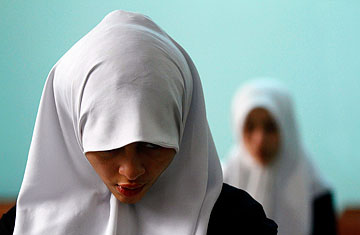
Excluded Only one-quarter of the region's women have jobs
During the arab spring, the Moroccan-born, London-based rap artist Master Mimz posted "Back Down Mubarak," a song for the Egyptian protesters, on YouTube. "First give me a job," she rapped. "Then let's talk about my hijab." The lyrics weren't merely catchy but also prescient. Over a year into the new Middle East, jobs and hijabs — or rather, women's roles in society — are still the biggest roadblocks to powering up postrevolutionary states. Across the region, governments are facing youth unemployment rates that in some countries are nudging 50%, while the issue of women's position in society and the economy continues to be fiercely contested in streets and salons, mosques and newly drafted constitutions.
Women played a starring role in the Arab Spring until attacks on female protesters in Egypt soured the prospect of women bettering their lot across the region. The percentage of women in Algeria's Parliament increased to 31% in May, but the number of Islamists grew as well in Tunisia, Egypt and Kuwait, where conservatives want new constitutions that chip away at women's rights.
Women's mores and gender issues are often a convenient touchstone for religiously inspired politicians eager to deflect attention from the more pressing issues of jobs and growth. (Just look at the presidential-primary season in the U.S.) That's especially true in the Arab world, where women's freedoms are caught in a centuries-old tussle between modernity and tradition. Tunisia's conservative Salafis staged university sit-ins this year demanding gender-segregated classes and the repeal of a ban on face veils. In the run-up to Egypt's elections, candidates all but ignored female voters for most of the campaign. Rather than confront the region's dire economic situation head-on, Mohamed Morsi, the candidate of Egypt's Freedom and Justice Party (FJP) — who opposes women's running for the presidency and on CNN recently championed protecting Egyptian women as he would "my sisters, my daughters, my wife and my mother" — has used religion as a distraction from a much bigger women's issue: jobs.
The economy and women's rights have long been separate issues in Middle Eastern public debate. But sexism is a costly business, holding back not just women but entire economies. This is true the world over but particularly in the Middle East and North Africa, which have the lowest rate of female participation in the global workforce. Only a quarter of Middle Eastern and North African women participate in the labor market, compared with over 50% in other developing regions, including sub-Saharan Africa and Central Asia. Moreover, as the region's unemployment rates have shot up, the gap between female and male rates has grown, doubling over the past generation. If you're an Egyptian, Kuwaiti or Saudi Arabian woman, you're four times as likely to be unemployed as a man in your country. "Women's disenchantment is very high," says Simel Esim, an economist at the International Labor Organization's Office for Arab States. "You give them education, but then there aren't the jobs out there."
Even without the region's other economic challenges — like slow growth, crony capitalism and bloated public sectors — gender discrimination is a recipe for disaster. A 50% rise in the wage gap between men and women lowers a nation's per capita income by 25%, economists Tiago Cavalcanti and José Tavares found. Getting women into the workforce correlates with higher growth and lower poverty rates and can yield far better growth than more conventional market reforms. A study last year from the Cass Business School Dubai argued that putting 2 million of the Gulf region's women into paid work would boost the GDP of the Gulf countries by 30% — or $363 billion.
To avoid the fate of their predecessors, the new Arab leaders know they need to create more jobs. To keep unemployment rates from rising further, the region will need almost 200 million new jobs by 2050 — three-quarters of them for women. In the World Economic Forum's 2011 Global Gender Index, the Middle East and North Africa (MENA) lagged behind the rest of the world, with Oman, Morocco, Saudi Arabia and Yemen in the bottom 10 of the 135 countries surveyed. At current rates, catching up with the world average for female labor participation will take the region 150 years.