

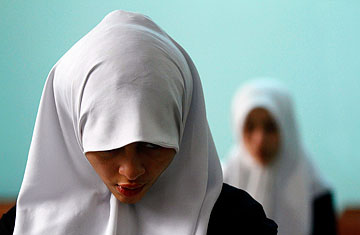
Excluded Only one-quarter of the region's women have jobs
(3 of 3)
Post — Arab Spring, the region's economies must promote the high-growth private sector in order to succeed. The fact that in many parts of MENA, women outperform men in terms of education can help. The Gulf in particular has already poured money into female education, producing what development experts call a reverse gender gap: Primary-school girls in the Middle East are the only ones on the planet who trounce boys in math tests. In Qatar, Kuwait, Saudi Arabia and other countries, there are more women than men in universities — and they tend to do better there too. The tough part is translating all this education into jobs. Unemployment in the region is particularly high for college graduates; 43% of Saudi Arabia's graduates, for example, are out of work. "There's a waste going on," says Saadia Zahidi, a senior director at the World Economic Forum. "Governments have made investments in education, but they're not reaping the returns."
And the political environment in which to do so is becoming more challenging. After Egypt's FJP — the political arm of the Muslim Brotherhood — swept 47% of parliamentary seats, investors and feminists worried about the tone coming from its conservative flank. In the new Egypt, the issue of women's empowerment has been tainted by its associations with President Hosni Mubarak's government: conservatives dismiss progressive legislation on women's rights, championed by the former First Lady, as Western-influenced window dressing by a corrupt regime. Egyptian women fear a more conservative constitution. Egypt's parliament is now only 2% female, down from 12% under Mubarak. "Women's unemployment was and is not a real priority with any serious political commitment," says Hoda Rashad, a social scientist at the American University of Cairo. "If anything, the commitment is much weaker postrevolution." One parliamentarian has sponsored a bill to roll back women's right to request divorce. Another has tut-tutted over school textbooks, claiming that they encourage girls to abandon their roles as homemakers to work in men's jobs. A bill currently making its way through parliament would lower the legal age of marriage from 18 to 16, a change that Gauri van Gulik of Human Rights Watch says could drag more women away from the labor force.
Green Shoots
there are pragmatists in egypt's Islamist FJP, however, who argue that women must be as involved in building the new Egypt as they were in tearing down the old one. Earlier this year, an official statement asserted the party's "commitment to equality and justice to women, particularly at this time when Egypt needs the efforts and creativity of every Egyptian citizen." Parliament recently voted to add 5 million female heads of household to the national-health-insurance program. There's a new registration drive for the 4 million Egyptian women who lack national IDs, without which they have trouble getting everything from education to jobs to capital. The Muslim Brotherhood does "believe in a free-market economy, but they've also made a commitment to help the most needy in society," says Maha Azzam, a Chatham House expert on Islamist movements. "I haven't encountered any resistance to the integration of women into the economy — on the contrary. The main stumbling block is to get the economy up and running."
The country that's done best at getting women into jobs is the one in which the Arab Spring began: Tunisia. That's not surprising given that it had been comparatively progressive within the region and developed a more diversified economy in female-friendly sectors like textiles, tourism and light manufacturing. It's also the country with the most-progressive legal protections for women, who have been guaranteed everything from workplace rights to access to abortion since 1956. And yet for all the structural and cultural reasons outlined, young women's unemployment still hovers around 28%, with many of the employed stuck in low-paid and insecure jobs. What the region needs, says economist Klasen, "is new thinking about a growth strategy, one with more intensive labor — and more female labor."
Those best placed to provide it may be female leaders themselves. Bothaina Kamel, the only female candidate in Egypt's presidential elections, withdrew from the race last month, having failed to secure enough signatures to get on the ballot. But the broadcast journalist's campaign, with its bell-clear denunciation of the interim ruling council, shook things up. Kamel has pledged to keep fighting corruption and fraud. Her failed electoral bid is yet another reminder to Egypt's women that while the old regime is gone, the old military and Islamist patriarchy remains. "We haven't made a revolution yet," she told interviewers. "There's still a lot more to do."