

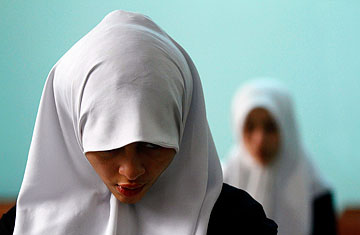
Excluded Only one-quarter of the region's women have jobs
(2 of 3)
It needn't. "In the West, there was a very large increase in female labor after World War II," observes Cavalcanti. "Men went to war, so women went into the labor market. A shock like that changed society's preferences about women in the workplace. For the Middle East, the revolution could be a shock that improves economic participation." With proper planning and political buy-in, it's just possible the Arab Spring could galvanize women into new roles. Already it's clear that the women who came out on the streets to topple dictators won't go quietly back to their homes, despite harassment by conservative Islamists or the military police. "What's refreshing in the post — Arab Spring environment is that women are coming out and articulating, very vocally, the need to have their rights," says Tara Vishwanath, lead economist at the World Bank's Poverty Reduction and Economic Management group.
Libyan women, who were pivotal in toppling Muammar Gaddafi's regime, still want a greater role in the public sphere, and many are expected to run in the June elections. In Egypt, activists are pushing sexual-harassment issues into the mainstream, with the liberal Free Egyptians Party recently marching alongside women's groups demanding antiharassment laws.
That's to the good. The MENA region's women have long been hampered by discrimination within the family, at work and under the law. And yet Islam doesn't actually discourage women from working: the Prophet Muhammad's first wife Khadija was a successful businesswoman who hired the Prophet to oversee her caravans. In other Muslim countries, women work in droves. Indonesia has a similar economic DNA to Egypt's — and twice the rate of female labor participation. Conservative Arab social and cultural mores play a greater part in keeping women out of the workforce. "Though women are educated, their fathers and husbands often want them to stay at home and take care of families rather than contributing to earning," says Tania Moussallem, head of strategic development and financial management at Lebanon's BLC Bank.
Hitting Where It Hurts
laws in the mena region don't help matters, hampering women's freedom of movement, work opportunities and access to capital. If you're a girl in Iran, you can legally be married at 13; a Bahraini girl can be married at 15. An Egyptian woman can't work the night shift, by law. An Omani or Saudi businesswoman can't get a passport without permission from a male family member. A Yemeni woman can't leave her house without an escort or permission from a male family member. And across the region, aspiring female entrepreneurs have more trouble getting bank loans than their brothers do. Since women customarily inherit less than men, they often lack collateral to get a loan. "Inheritance laws don't favor women," notes Moussallem. "And even if they are equitable in some countries, there is a mentality where families give assets to a boy because he holds the family's name."
Particularly in the era of globalization, the region has paid dearly for such discrimination. Much of the success of East Asian economies like China, Vietnam and Indonesia has hinged on getting women into work and building a competitive export-oriented manufacturing sector on female labor, notes Stephan Klasen, a professor of development economics at the University of Göttingen. Comparing these tigers to the MENA region's sluggish economies, Klasen and economist Francesca Lamanna estimated that the MENA economies would have grown 1% faster per year than their 1.6% growth rates during the 1990s had the region tapped into its female talent as the East Asians did. And by comparing female-to-male earnings ratios, economists Calvacanti and Tavares found that were it not for Saudi Arabia's wage gap, the Saudi population would be as rich as that of the U.S. on a per capita basis. If American women faced pay inequalities on a par with Egyptian women, U.S. output per capita would plummet by 66%. "When men discriminate, they may be better off individually, simply because they are doing better than women," says Tavares. "But overall, the economy suffers. If you're barring women from the workforce or paying them a lesser wage, then you're not bringing women in as productive members of the economy."
So far, across the MENA region, governments remain the biggest suppliers of jobs. That's not necessarily a bad thing for women, who "prefer to work in the public sector because it pays much better and offers more generous benefits than a private-sector job," says the World Bank's Vishwanath. Studies show that the region's women tend to see working in the private sector as riskier to their reputation than government work because of longer hours, long commutes and the potential for harassment. The jitters are mutual, notes Vishwanath: "Firms, too, perceive women to be less productive and more costly," since their leaving the workforce when they marry increases turnover.