

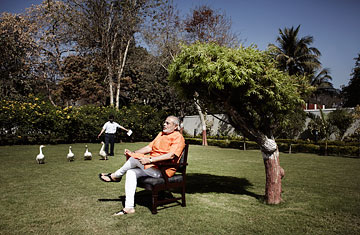
Designs on Delhi Modi is tipped as a contender to be India's next Prime Minister
(3 of 3)
His ability to get things done is in stark contrast to the Congress-led central government in New Delhi. "If you look at the rest of the country, who's in charge is a big issue, if at all anybody's in charge," says Sebastian Morris, a professor of economics at the Indian Institute of Management in Ahmedabad. "The difference here is that somebody's in charge, whatever he may do." In a recent opinion poll by the magazine India Today, 24% of those surveyed thought Modi should be the next Prime Minister; Rahul Gandhi polled 17%. Still, winning the top job in New Delhi won't be easy for Modi. Despite his successes at the state level — two re-elections with solid majorities and an unmatched record on economic growth — Modi is unpopular with the BJP's national leaders. Some covet the prime ministership for themselves and resent that Modi has become the most visible face of the BJP.
The Muslim Factor
Modi does need, however, the support of Muslims. What bothers him, more than accusations of arrogance or high-handedness, is the idea that Muslims in his state might be anything other than smiling, contented Gujaratis. He hands TIME a BJP pamphlet about Muslims. It bears the stilted rubric: WE ARE PROUD TO BE IN GUJARAT ... WHERE WE REALLY SMILE. On the cover is a beaming Muslim family, and the text condemns the "malicious lies about Gujarat" as an attempt to "break the fast pace of progressive good governance" led by Modi.
The text highlights findings from the 2008 Sachar Commission, a landmark survey of Indian Muslims. While Muslims are worse off than Hindus by nearly every measure from health to income, their status in Gujarat is no worse than in other states and, by some criteria, is better. This is the core of Modi's political defense and appeal to the urban middle class, who have benefited most from Gujarat's success: that he has improved the lives of Gujarat's Muslims more than the politicians who have condemned the 2002 rampage but failed to deliver basic services. "Every community is reaping the fruits of development," says Ramvilas Shukla, head of a textile firm in Ahmedabad that has grown nearly tenfold over the past decade. "People are not bothered about politics. They want progress. Even if you interview a Muslim, they will speak in favor."
Some Gujarati Muslims do share Shukla's sentiments. Yet surface calm can mask a deep unease. In Naroda Patiya, a Muslim enclave of tailors, auto-rickshaw drivers and incensemakers in Ahmedabad, at least 68 people were killed in 2002 and thousands more driven from their homes. A quarter of the area's population left after the riots. Economic growth has lifted incomes for those who remain, but as Salim Mohammad Hussain, an auto-rickshaw driver, says: "We have no trust; we feel it can surely happen again. The fear is still in our minds."
During the disturbances, Modi supported Hindu nationalists' call for a general strike and allowed them to publicly display, in Ahmedabad, the bodies of the Hindu victims of the train fire — two decisions that have been widely criticized for inflaming anti-Muslim sentiment. When asked if he feels any remorse for what happened in 2002, he stiffens with controlled anger: "I don't want to talk about the subject. Let people say what they want to say. My actions speak."
Modi is so sure of himself that he is now openly courting Muslims, who have long voted for Congress by default. He faces state ballots at the end of this year, and the BJP's margins of victory have been shrinking. The party's success in getting about 140 Muslim candidates elected to local office has persuaded at least some Muslim voters to forget about the past for the sake of economic betterment. Muslims, says social scientist Suhrud, are "hedging their bets and saying, 'If Congress cannot guarantee us a thing, these people can guarantee us something — why not accept it?'" Trying to get Gujarat's Muslims to vote for him is an audacious play, shoring up not only Modi's position within the state but also his national ambitions. If he succeeds, India may never be the same.