

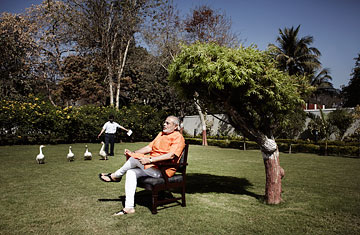
Designs on Delhi Modi is tipped as a contender to be India's next Prime Minister
Narendra Modi sits silently on stage in a posture of serene repose. The chief minister of the western Indian state of Gujarat, Modi is a controversial, ambitious and shrewd politician. Today, he is wearing the white of a penitent — he has embarked on a series of very public daylong fasts in front of thousands of supporters. It's Modi in makeover mode: an act of self-purification, humility and bridge building in a state that is still traumatized by the Hindu-led anti-Muslim massacres of 10 years ago and the flawed investigations in their wake. Modi says he wants Gujarat's people to come together. At one fast, a song proclaims, "Let's beat the drums for harmony/ Let's beat the drum for the chief minister." But Modi, a Hindu, manages to insult some Muslims by rejecting the shawls and caps they offer him as gifts. So, to TIME, the chief minister cannily changes tack, talking of his road show as an exercise in economic actualization instead of religious peace. "We must tell the other states ... think about unity," he tells TIME. "And if you do so, you can also grow as Gujarat is growing."
To his loyalists, Modi is a decisive leader deserving a bigger platform than Gujarat, deserving, indeed, of all India, and of the prime — rather than just a chief — ministership. To his critics, Modi is a strongman who presided over the worst episode of Hindu-Muslim violence in India since Partition. What's certain is that during his 10 years in power in Gujarat, the state has become India's most industrialized and business-friendly territory, having largely escaped the land conflicts and petty corruption that often paralyze growth elsewhere in the nation. Gujarat's $85 billion economy may not be the largest in India, but it has prospered without the benefit of natural resources, fertile farmland, a big population center like Mumbai or a lucrative high-tech hub like Bangalore. Gujarat's success, even Modi's detractors acknowledge, is a result of good planning — exactly what so much of India lacks.
This image of Modi — the triumphant technocrat — has overtaken that of Modi the Hindu ultra-nationalist. On Feb. 27, 2002, two train carriages carrying activists from a Hindu nationalist group were set on fire at the Gujarati town of Godhra, killing 58. A wave of organized retaliation rolled across Gujarat, in which as many as 2,000 Muslim men, women and children were killed, many mutilated, raped and burned alive; thousands of Muslim homes, business and shrines were destroyed. In the decade since that carnage, dozens of individual rioters have been convicted, but the state has never had to answer accusations that it failed to halt the violence: no top officials have been held accountable or had conspiracy charges proved against them. One case naming Modi remains open, a notorious incident in which nearly 200 people were killed while taking shelter in the home of a Muslim politician, Ehsan Jafri, whose desperate calls to government officials for protection were ignored. Modi denies ever hearing from Jafri, who was dismembered and killed. If this case also ends without any charges being brought, the last remaining obstacle between Modi and national office will fall.
India has seen other leaders overcome scandal or bloodshed, but none has been recast as completely as Modi. His background makes him the most polarizing figure in the country, not least because Muslims are India's largest religious minority after the majority Hindus. And yet "the future belongs to him," says Tridip Suhrud, a social scientist and expert on Gujarat. Indians are weary of the coalition led by the diffident current Prime Minister, Manmohan Singh, and the ailing, unapproachable president of his Congress Party, Sonia Gandhi. In three years the government has not passed one significant piece of legislation. India's economic boom, too, has lost steam, and Congress has become synonymous with corruption. With two years left before the next national election in 2014, Congress hopes its young scion, Sonia's son Rahul, will refresh the party, but a resounding loss in a recent state election makes him look vulnerable.