

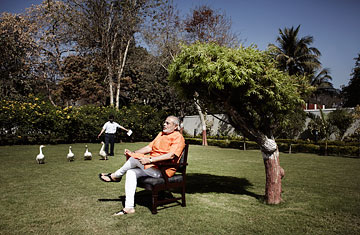
Designs on Delhi Modi is tipped as a contender to be India's next Prime Minister
(2 of 3)
Modi, 61, is perhaps the only contender with the track record and name recognition to challenge Rahul Gandhi. Many Indians recoil at any mention of a man whose name is indelibly linked to Gujarat's brutality of 2002; choosing him as India's leader would seem a rejection of the country's tradition of political secularism and a sure path to increased tension with Muslim Pakistan, where he is reviled. But when others think of someone who can bring India out of the mire of chronic corruption and inefficiency — of a firm, no-nonsense leader who will set the nation on a course of development that might finally put it on par with China — they think of Modi.
Boss Man
Modi left home at 17 to join the Rashtriya Swayamsevak Sangh (RSS), a group that promotes Hindu pride through the cultivation of charity and military discipline. He married early but never lived with his wife (and has since renounced conventional family life). Instead, he ascetically devoted himself to Hindu nationalist politics as a strategist for the Bharatiya Janata Party (BJP), which grew from the same Hindu nationalist roots as the RSS to become India's largest opposition party. He was rewarded with the position of chief minister of Gujarat in 2001, when a BJP-led coalition held power.
Unlike many Indian politicians, though, Modi doesn't put his faith on display. There are no religious icons in his office; the only adornments are two statues of his hero, the philosopher Swami Vivekananda. Everything about Modi and his surroundings is carefully manicured and controlled. He gives the impression of an autodidact who has methodically plotted his journey from small-town boy to CEO of Gujarat. A key message is that he is a self-made man, succeeding without family connections or fancy education, and his appeal is obvious in a nation of strivers.
In a country where nepotism and dynastic politics are the norm, Modi's family (he is the middle child of nine siblings) is invisible. One younger brother works in the state government but "he has never come to my office in the last 10 years," Modi says. "This is the discipline in my family, and I feel proud of it." Discipline comes up often in conversation with Modi — as an implicit rebuke to the typically chaotic, haphazardly organized model of Indian governance. He says he sleeps only 31/2 hours a night, waking at 5 a.m. for 90 minutes of yoga before work. "In the last 10 years, I have not taken even a 15-minute vacation," he boasts.
Modi has certainly been industrious about the rehabilitation of his image post-2002. He has never shown any remorse for the anti-Muslim carnage, instead praising Hindus for their "restraint under grave provocation." But the growth and consolidation of his power has not been based on religion and ideology alone. Instead, Modi has set about revamping the state's economy by attracting high-value manufacturing companies, whose bosses are now among his staunchest backers. "He must have realized that one cannot win elections only through emotions," says Ghanshyam Shah, a political scientist in Gujarat's largest city of Ahmedabad and the author of several books on democracy in India. "One has to perform so that people can see the tangible benefits."
Modi took Gujarat's natural advantages — its long coastline, nonunionized labor force and a developable land bank of thousands of acres — and added the streamlined bureaucracy and reliable electricity supply that big industry craves. Today Gujarat is the only state in India where both big businesses and small farmers can expect an uninterrupted power supply for nearly 24 hours a day, with the premium rates paid by big business used to subsidize rural electrification. In 10 years, Gujarat's auto industry has grown from one modest plant to an expected capacity of 700,000 cars in 2014, including billion-dollar investments announced last year by Ford and Peugeot. "It is not luck," Modi says. "It's a carefully devised process."