

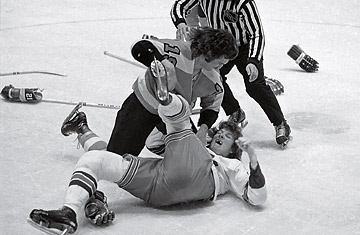
Rick MacLeish of the Philadelphia Flyers prepares to pound Jerry Butler of the New York Rangers.
In Hockey circles, they're known as tough guys, goons, enforcers. They're sluggers on skates. The job description is simple: You touch one of our talented players, our goal scorers, I pummel your face. Underneath the cocky, growling exterior of some hockey fighters, however, is something surprising: fear. Crippling fear. The kind that can keep you up all night before a game, stomach churning, half-wishing that when you do fall asleep, you don't wake up the next day.
Jim Thomson knew the feeling. A former enforcer, he played for six National Hockey League teams from 1986 to '94 and protected, among others, Wayne Gretzky. For Thomson, a steady diet of booze and painkillers helped untangle the late-night knots in his gut. He'd never let on, but whenever Thomson knew he'd have to fight the next day, he was terrified of getting his ass kicked in front of 15,000 fans howling for blood--his blood.
The NHL's enforcers, many of them marginally skilled at best, often become rent-a-fighters who drift from team to team until their usefulness runs out. Thomson says he sustained six documented concussions in his pro career and failed to report dozens of others. He's convinced that these blows to the head, received in dozens of fights, contributed to his anxiety, depression and addiction. Recent scientific research suggests such a connection. After Thomson's playing days ended, his addiction intensified and his depression worsened. At his low point, he curled up in bed, strung out on drugs and alcohol, thinking about taking his own life. "I know what being an enforcer did to me, how it destroyed me," Thomson says.
Thanks to stints in rehab, Thomson was able to bounce back. He now trains hockey players and does some motivational speaking. Others haven't been so lucky. The recent deaths of three enforcers highlighted the potential link between head trauma and mental illness and ignited a debate about whether fighting should have a place in the NHL. In May, the New York Rangers' Derek Boogaard, whose 2010--11 season was cut short by a concussion, died of an accidental overdose of a painkiller and alcohol. Boogaard had a history of substance-abuse problems. On Aug. 15, Rick Rypien, a former Vancouver Canucks player who had just signed with the Winnipeg Jets, killed himself after a decadelong struggle with depression. Two weeks later, Wade Belak, a recently retired defenseman for the Nashville Predators, hanged himself. (Belak's parents have described his death as an accident.)
While of the three, only Rypien's issues with depression were well known, we are aware that mental illness carries a stigma in pro sports and can go hidden. And while only Boogaard had a documented history of concussions, we know that pro athletes often refuse to report concussions, afraid that time off the ice will cost them a job. Belak, Boogaard and Rypien got into over 400 pro-hockey fights combined; accumulated subconcussive blows to the head may lead to addictive behavior and depression.