

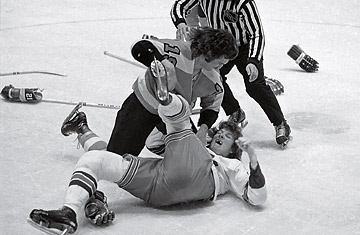
Rick MacLeish of the Philadelphia Flyers prepares to pound Jerry Butler of the New York Rangers.
(2 of 3)
You can't draw definite conclusions about the root cause of this year's tragedies, but some scientific hints are disturbing. A Boston University research center has diagnosed two former enforcers with chronic traumatic encephalopathy (CTE), a degenerative brain disease found in people who have sustained repeated blows to the head. The enforcers were Bob Probert, one of the toughest players of all time, who died in 2010 of heart failure, and Reggie Fleming, who played in the prehelmet days and passed away in 2009 at 73. Fleming, a fierce and fearless player, had suffered from dementia and other CTE symptoms for 30 years. (CTE symptoms include substance abuse and depression and can be diagnosed only postmortem; the Boston University lab is conducting a study on Boogaard's brain.)
After several NFL players were diagnosed with CTE, football took steps to make that game safer. Hockey is trying to do the same. In January, NHL commissioner Gary Bettman noted that concussions are on the rise. If the league wants to reduce head trauma and the risk of its players going through hell, why not scrap a tradition that involves multiple bare-knuckle punches to the head? "The role of the enforcer must go," says Thomson. "What are we waiting for?"
Hockey fighting has passionate defenders, though, even among the ex-enforcer ranks. "The beauty of our game is the diversity," says former enforcer Ryan VandenBussche, who served 70 penalty minutes for each of the 10 goals he scored in nine years in the NHL. "We give the fans what they want." In early October, one of hockey's highest-profile figures, irascible ex-coach and Hockey Night in Canada broadcaster Don Cherry, went so far as to call Thomson and two other enforcers "turncoats," "hypocrites" and "pukes" because Cherry thought they wanted to eliminate fighting. (Two of them didn't; Cherry later apologized.)
Bullies and Blood Sport
Since the dawn of hockey, fighting has been ingrained in the game. Screamed one Toronto Star headline during the NHL's first season, in 1918: "Two NHL Players Under Arrest in Charge of Fighting, Fighting Players Remanded for Sentencing." After the Philadelphia Flyers of the 1970s, known as the Broad Street Bullies, intimidated their way to back-to-back Stanley Cups, teams started an arms race (a fists race, really) to stockpile enforcers. The 1977 film Slap Shot--which starred Paul Newman as a player-coach of a minor-league team that signs a trio of bespectacled goons--glorified hockey as blood sport.
By the early '90s, the NHL began dishing out 10-game suspensions to players who left the bench during a brawl. After a lockout shut down the 2004--05 season, the NHL allowed longer passes and enforced rules against hooking and holding in order to emphasize skill and win back fans. These changes have allowed the game to flow, and with fewer stoppages and less clutch-and-grab defense, players are not as inclined to drop their gloves and square off. Today, according to the NHL, fighting is down more than 50% from its late-1980s peak, to less than a fight every two games.