

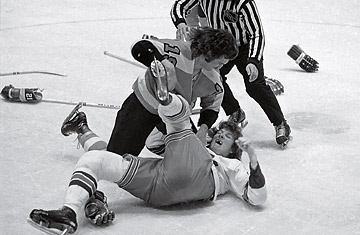
Rick MacLeish of the Philadelphia Flyers prepares to pound Jerry Butler of the New York Rangers.
(3 of 3)
Not only is fighting less prevalent; its defenders point out that it's far from the main cause of concussions. According to research from St. Michael's Hospital in Toronto, fighting causes 8% of all diagnosed NHL concussions. Moreover, fighting proponents insist that throwing punches actually makes the game safer. If the NHL were to ban fighting, the argument goes, concussions could increase: without fear of retribution from enforcers, players might feel freer to take cheap shots. "It's not a gratuitous 'We like fighting,'" says ex-player Brendan Shanahan, now the NHL's chief disciplinarian. Players may be more likely to use their sticks as weapons, for example.
But the NHL is already handing out stiffer penalties for egregious hits to the head while the puck is in play. So why, if fighting were banned, would stick-waving maniacs suddenly emerge? Dr. Robert Cantu, a co-director of the Boston University concussion lab, labels as "horsebleep" the assertion that fighting causes just 8% of hockey concussions, since the research measures only diagnosed concussions. Judging by the enforcers he has examined, he says hockey fighters suffer concussion symptoms "about once every four fights."
And even if we suppose that fighting causes only 8% of concussions, aren't these worth eliminating? Football refs immediately break up brawls. If you fight in a soccer match, your team plays a man short for the rest of the game. Hockey in the Olympics and at the collegiate level in the U.S. survives without fisticuffs. Why can't the NHL? "We evolve with the times," says Thomson. "We once smoked on airplanes, but we stopped doing that when we found out it was killing us. Where do you see more head shots than in a hockey fight? Why don't we start at the top?"