

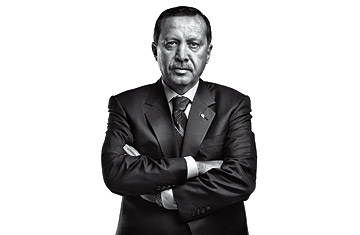
Portrait of Prime Minister Erdogan
(4 of 4)
Erdogan's initiatives with Syria have similarly unraveled. When the Arab Spring inspired an uprising against Assad, Erdogan tried to coax the Syrian leader into implementing political reforms. "He overestimated his ability to persuade Assad," says F. Stephen Larrabee, an expert on Turkey at the Rand Corp. Once Assad reneged on his promise of reforms, Erdogan grew openly contemptuous of the Syrian strongman. "It is impossible to preserve my friendship with people who are allegedly leaders when they are attacking their own people," he says. In recent weeks, the rhetoric has grown sharper still: Erdogan has explicitly called for Assad's resignation, and the Syrian has accused his former friend of imperial ambitions. Turkey openly supports and shelters anti-Assad groups, and Assad loyalists have attacked Turkish diplomatic offices.
The break with former allies may have dashed Erdogan's hopes of being a regional peacemaker. It also complicates matters for the U.S., which had hoped Turkey could gradually draw Syria away from the Iranian sphere of influence. Nor does it help that the U.S.'s two closest allies in the region, Turkey and Israel, are now at loggerheads.
Other challenges abound. Erdogan's diplomatic head start in the Arab Spring countries will be difficult to maintain as other regional and world powers jockey for influence. And domestically, his position is far from unassailable. He is notoriously thin-skinned about criticism and paranoid about coups. (The latter is perhaps understandable: the Turkish military overthrew four elected governments in the 40 years before the AKP's 2002 victory.)
And for all the Erdogan government's desire for Turkey to be seen as a modern state equal in freedoms to any in Europe, Ankara has jailed 68 journalists, accusing them of complicity in coup plots. Likewise, its treatment of Turkey's Kurdish minority has fluctuated between promises of political compromise and old-fashioned military repression.
In the political arena, Erdogan's next goal is to rewrite the Turkish constitution. Fears that he will dilute the nation's secularism have been replaced by a concern that he will push for executive power to be concentrated in the office of the President and then seek that office himself. The presidency is currently a mostly ornamental position, held by Erdogan's longtime ally Abdullah Gul. Istanbul salons are rife with talk of the two men switching roles after the constitution is rewritten, drawing comparisons to the Medvedev-Putin swap in Moscow. It's a testament to how far the Islamist icon has come. His critics no longer worry that he may turn Turkey into another Iran. They now fear he will turn it into another Russia.