

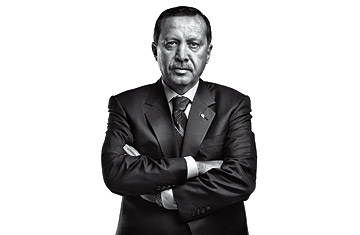
Portrait of Prime Minister Erdogan
(3 of 4)
For some western observers, the rise of political Islam conjures up visions of extremist, reactionary states, like Iran or Afghanistan under the Taliban. That limited view informed the anxiety that greeted the AKP's 2002 election victory. Even Turkish secularists feared Erdogan would seek to undo the separation of mosque and state that was the foundation of Mustafa Kemal Ataturk's establishment of modern Turkey in 1923. They pointed to comments Erdogan made in the 1990s, as mayor of Istanbul, like this one: "Democracy is a tram that gets you to your destination, and then you get off." Turkey's decision not to participate in the 2003 Iraq war led to fears that Erdogan would take his country out of NATO and turn away from the West.
But the AKP's critics were wrong: Turkey didn't become another Iran. Apart from the repeal of a long-standing ban on the Islamic headscarf in universities last year, Erdogan's policies have hardly been an assault on Ataturk's secular legacy. And far from drifting away from the West, Erdogan has pushed harder than his predecessors for the ultimate Western endorsement: admission to the European Union, whose repeated cold-shouldering of Ankara says more about European hang-ups than Turkey's qualifications. Erdogan tells TIME he is "still determined" to pursue E.U. membership but can't help smiling at the irony that his country, once described as "the sick man of Europe," is now economically ascendant, while many members of the club that won't admit him are all but bankrupt.
More Than Zero Problems
Almost immediately after coming to power in 2002, the AKP government reached out to Jewish Israel and the secular Syrian regime of President Bashar Assad as part of a foreign policy doctrine that Erdogan dubbed Zero Problems, which was designed to mend relations with all its neighbors. For a while, it worked: Erdogan formed a close bond with Assad, even inviting the Syrian dictator to vacation in Turkey. And Turkey quickly became Israel's best friend in the Islamic world (a bar that was, admittedly, low).
But its ties with both Israel and Syria have foundered recently. Relations between Turkey and Israel, already at odds over a December 2008 Israeli assault on Gaza that left more than 1,300 Palestinians dead, broke down completely in May 2010, when Israeli commandos halted a Turkish-led aid flotilla bound for Gaza in international waters. In the fighting that broke out, eight Turks and one Turkish American were killed. Israel claims its troops were attacked on board. Erdogan says that nothing short of a formal apology and the lifting of Israel's blockade of Gaza will repair a once promising friendship.