

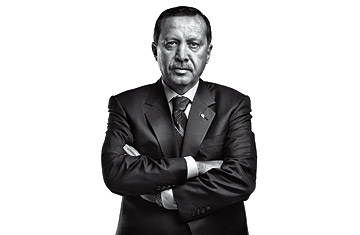
Portrait of Prime Minister Erdogan
(2 of 4)
But perhaps its greatest virtue, in the eyes of many, is that the Turkish model was forged by an Islamist: Erdogan and his Justice and Development Party--better known by its Turkish initials, AKP--have traditionally drawn support from the country's religious and conservative classes. For Arab Islamists, Turkey's success is proof that they can modernize their countries without breaking away from their religious moorings. Erdogan's Western admirers see it the other way around: as proof that political Islam needn't be an enemy of modernity. And if any evidence were needed that Erdogan's way leads to political success, the AKP won its third general election in June, by a landslide.
But can the Erdogan way lead Egypt, Tunisia and Libya to the political stability and economic strength Turkey now enjoys? Erdogan claims to be ambivalent whether Arab states seek to emulate his success. "If they want our help, we'll provide any assistance they need," he told TIME in an interview during his visit to New York, but "we do not have a mentality of exporting our system." Even so, he doesn't deny reaching out to the potential leaders of the Arab Spring states: "I wanted to talk to the presidential candidates, and I had the opportunity to get together with lots of people in order to grasp the situation."
His message to them: be good Muslims but make sure your constitution is, like Turkey's, secular. "Do not fear secularism, because it does not mean being an enemy of religion," he said in an interview on Egyptian TV. "I hope the new regime in Egypt will be secular." This came as a shock to some in the Muslim Brotherhood, who retorted that they didn't need lectures from the Turk. The episode was a reminder that Turkish Islamism, rooted in a secular democratic tradition, is not so easily transplanted to societies where neither secularism nor democracy is well understood. The template, says Michael Werz, a Turkey expert at the Center for American Progress, "can be inspirational for Arab Islamist parties, but it can't be a model."
All the same, many politicians in the Arab Spring countries are plainly modeling themselves after the Turkish leader. "Erdogan wears a business suit, but he prays in the mosque. That is something we can identify with," Essam Erian, a top leader of Egypt's Muslim Brotherhood, told me in Cairo in the summer. (There's an obvious echo in the name of the Brotherhood's new political arm: Freedom and Justice Party.) Abdelhamid Jlassi, a leader of Tunisia's Islamist Ennahda party, was just as starry-eyed when I met him in Tunis a few days later. "Erdogan speaks our language," he told me. "When he speaks, we listen."
Ennahda has since won a large plurality in Tunisia's first free elections, on Oct. 23, to form an assembly that will write a new constitution. In Egypt, the Muslim Brotherhood is expected to do just as well in elections that began Nov. 28. Libya will probably not go to the polls until the middle of next year, but there, too, Islamist groups are tipped to be significant players. Where--and to whom--they look for inspiration could change the way the world views them.
The Ideal Islamist