

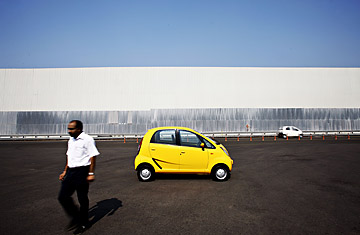
Sales of the touted "people's car" have been low.
(4 of 4)
For now, Tata Motors is trying to boost production by selling Nanos in other parts of the subcontinent where market conditions are similar to India's, with motorcycles far outnumbering cars. But even in places like Sri Lanka, where 700 Nanos have been sold since May, there are image problems. Nayanajith Thilekarathana, a businessman in Colombo, bought a Nano recently for about $10,000. (The bigger tab is due to Sri Lanka's extremely high import duties.) The Nano is significantly less expensive than other imported cars, but after several local taxi services started cruising the streets with GPS-equipped Nanos, it acquired a new label. "I have had people coming to me asking whether this is 'that taxi car,'" he says with disgust. "People still want a vehicle to be a status symbol, and that sometimes overrides convenience and economics."
As any number of emerging-market companies--from Japanese electronics makers like Sony to Korean car giant Hyundai and, more recently, Chinese appliance makers like Haier--can attest, building a great brand takes time. "This is a 10-to-15-year process," says Ashish Singh, chairman of Bain India. For now, Tata Motors' first step will be replacing Carl-Peter Forster, who abruptly resigned as CEO in September because of "unavoidable personal circumstances" after less than two years at the company. Tata Motors claims it's in for the long haul, and it has plans to launch a version of the Nano for Europe, the Tata Pixel, within three years, aimed at space-squeezed urbanites coping with recessionary budgets. Given its economic problems, maybe Europe is the continent where austerity will trump emotion.