

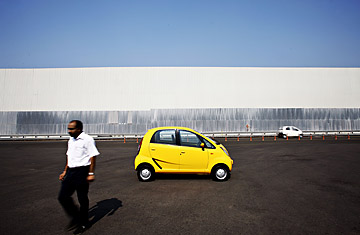
Sales of the touted "people's car" have been low.
(2 of 4)
That disruption may have undermined the original premise of the Nano--a car at a price competitive with motorcycles'. Abdul Majeed, an auto-practice leader for PricewaterhouseCoopers in Chennai, says that despite the worldwide publicity for the one-lakh, or 100,000-rupee ($2,000), car, the actual tab after taxes, transportation costs and basic add-ons like air-conditioning was closer to $3,700. With reduced capacity, Tata Motors could not get the volume needed to maintain the promised price. At the higher amount, the Nano was competing not with motorcycles but with established small cars like the Maruti 800, which begins at about $4,500. If customers can get "a slightly better vehicle for not much more money," Majeed says, they will, and Nano's edge disappears. "I think the fundamental reason is pricing."
Tata Motors rejects that criticism, saying surveys show customers are satisfied with the pricing. The one-lakh figure, says a spokesman, was just a goal for the engineers, but it was always meant to be the base price for a car fresh off the factory floor.
Fairly or not, the Nano's nickname reflects its extreme engineering. Not only were the usual compact features stripped out, but the Nano was also designed and built from scratch, minimizing curves and the number of components in order to simplify production. Its widely admired engineering wasn't enough, though, to get people to buy it. Tata Motors had 200,000 preorders for Nanos in the months after the launch, but with so few cars in production, each sales outlet had just one Nano. Dealers were not allowed to send them out for test drives, so customers could only look at the car. A mere 30,000 Nanos were sold in the first year.
Tata Motors also didn't bother to advertise the car right away, so the only message that potential customers heard was the worst possible kind: there were at least six reported cases of Nanos catching fire, in one instance while the owner was driving the car home from the dealership after purchasing it. (No one was injured.) Murad Ali Baig, an auto analyst and columnist in New Delhi, says the company did not give a clear explanation quickly enough about what happened to the cars. That lack of clarity, he says, "created a great deal of anxiety that the car might not be as safe as it's cracked up to be."
Tata Motors, which claims the car is perfectly safe, eventually traced all the problems to "foreign objects" that had gotten lodged in the car or unauthorized equipment that had been installed. The company also added a shield to the catalytic converter, which gets very hot, to reduce the risk of combustion. Still, the damage was done. By November 2010, monthly sales had dipped as low as 509 units.
The Nano's first marketing campaign--which began in December 2010, to coincide with the beginning of nationwide open sales--tried to right things with ads that stressed the practical virtues of the car: its sturdiness and its fuel efficiency. Television commercials stressed traditional life and middle-class respectability, a vision of an India where an entire village turns up to greet its first Nano and where parents wait for their children to fall asleep in the car before holding hands.