

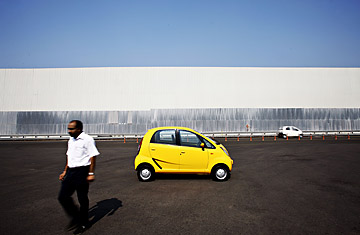
Sales of the touted "people's car" have been low.
(3 of 4)
Yet this strategy was out of step with that of the Nano's stated competition, India's most successful motorcycle makers. In one slick ad, the Bollywood heartthrob Hrithik Roshan descends from a moving helicopter, action-hero style, while on a Hero bike. In another, movie star Priyanka Chopra plays a sassy small-town belle who takes a hapless suitor for a ride on her cherry-red Pleasure scooter, then ditches him with the tagline "Why should boys have all the fun?"
Critics of the Nano's ad campaign say it missed a big part of the reason Indians buy cars: they aspire to a life that's more glamorous than the one they know. Even those who have bought Nanos reflect that, since 38% of them opted for the most expensive model and only 20% went for the basic one. "The Indian market has shown that it's willing to move up," says Baig. "Money isn't everything." Baig, who drives a Nano in his posh South Delhi neighborhood, says Tata Motors would do better to aim its marketing at consumers like him, a small but influential group of "reverse snobs" who can afford any car but like the Nano because it's famous and convenient. A few high-profile Nano drivers among India's 190,000 millionaire households might do a lot to popularize it among the country's 100 million-strong middle class--a market that has doubled over the past five years, according to Goldman Sachs.
Meanwhile, Tata's competitors are starting to figure out the complexities of the Indian mass market. Ford, for example, has avoided the ultra-low-cost-car category in India and has sold 115,000 of the $7,500 Figo since its launch in March 2010. Michael Boneham, managing director of Ford India, estimates that 70% of the Indian car market lies in the $7,300-to-$12,200 range. "Beyond that, the volume drops off pretty quickly," he says. In marketing the Figo, Ford emphasizes the advanced technology, like Bluetooth, available even at the low end. "This perception that Indians want cheap is a little misleading," he adds. "They didn't need to go in at absolutely the very lowest level. They want to demonstrate to their friends and family that they're succeeding."
Tata Motors defends its marketing strategy and says all it has to do to get sales going is get the Nano closer to where the target customers are, in small towns and villages. Nearly all of its 619 sales outlets are in big cities, so the company is trying to expand into towns with populations under 500,000, opening locations that sell and service only Nanos. Six are in operation so far, with 300 more planned by the end of 2011. "Had we been able to enter the market at full capacity, all this would have taken place much earlier," the Tata spokesman says. "We set a certain footprint. Now we have to expand that footprint." A bigger footprint is crucial to the Nano's business model. Majeed estimates that Tata Motors would have to run its Nano factory at 80% to 90% of capacity to make a profit because margins are so low.